

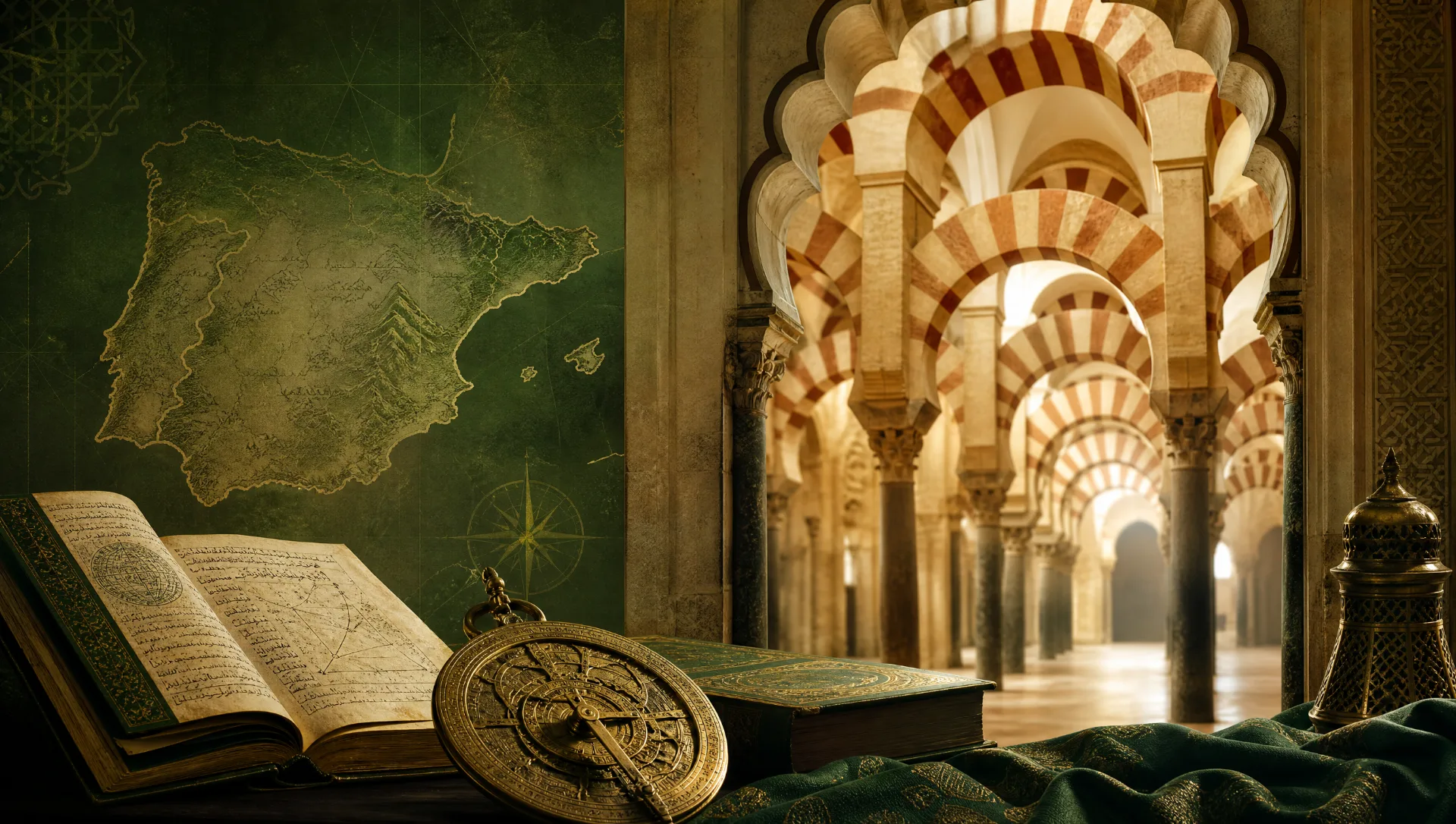
The arrival of Islam in Al-Andalus: history, rise and realities
Discover the factual history of the arrival of Islam in Al-Andalus starting in 711. Between historical rigor and the realities of Cordova's intellectual rise, a look back at this major period.
L'équipe Muslim Map
Guides halal & voyages musulmans · Mis à jour le 7/18/2026
In the year 711, the destiny of the Iberian Peninsula shifted with the landing of Muslim forces led by Tariq ibn Ziyad. This event marked the beginning of Al-Andalus, a political and cultural space that would influence Europe and the Muslim world for nearly eight centuries.
Far from romanticised accounts, the history of Al-Andalus is characterised by great political complexity, a major intellectual rise, and rigorously defined social structures.
📍 The Turning Point of the Year 711: The Expedition of Tariq ibn Ziyad
At the beginning of the 8th century, the Visigothic kingdom that dominated the Iberian Peninsula was going through a major succession crisis. It was in this context of political fragility that the governor of Ifriqiya, Musa ibn Nusayr, ordered a military reconnaissance expedition.
In the spring of 711, the Berber general Tariq ibn Ziyad crossed the strait that would bear his name (Jabal Tariq - Gibraltar) with an army of about 7,000 men. In July of the same year, the decisive victory at the Battle of Guadalete against the Visigothic king Roderic precipitated the fall of the kingdom. Within a few years, most of the territory came under Umayyad control.
The term Al-Andalus refers specifically to the territories of the Iberian Peninsula (present-day Spain and Portugal) under Muslim sovereignty between 711 and 1492. Its geographical borders constantly fluctuated.
📅 Chronology of the Major Stages of Al-Andalus
The political evolution of Al-Andalus was structured into several distinct phases, marked by strong centralisation followed by progressive fragmentation:
- 711 - 756: Period of governors dependent on the Umayyad Caliphate of Damascus.
- 756: Foundation of the independent Emirate of Cordoba by Abd al-Rahman I, a survivor of the Umayyad dynasty.
- 929: Proclamation of the Caliphate of Cordoba by Abd al-Rahman III, marking the political and economic peak.
- 1031: Fall of the Caliphate and splintering into rival micro-states (the Taifas).
- 1238 - 1492: Retreat to the Kingdom of Granada, the last Muslim bastion before the final capitulation.
🕌 Cordoba: Sunni Intellectual and Theological Centre
Under the impulse of the emirs and then the caliphs, the city of Cordoba became one of the most populous and developed metropolises in the West during the 10th century. It directly rivalled Baghdad and Constantinople in the fields of science and the arts.
The Stabilisation of the Maliki School
On the religious front, Al-Andalus almost exclusively adopted the Sunni Maliki school. This legal school, introduced by scholars who had travelled to Medina, provided a stable and rigorous legal framework essential for administering a multi-ethnic empire.
Major Scientific Contributions
Andalusian scholars did not merely translate ancient heritage; they made fundamental corrections and innovations to it:
- Medicine: Al-Zahrawi (Abulcasis), considered one of the fathers of modern surgery, wrote the Al-Tasrif, a medical encyclopedia illustrated with surgical instruments of his own invention.
- Philosophy and Jurisprudence: Ibn Rushd (Averroes), qadi (judge) of Cordoba, commented on the work of Aristotle while defending the compatibility between Islamic revelation and philosophical rationality.
- Theology and Grammar: Ibn Hazm, a prolific author, codified the Zahiri legal school and produced highly rigorous comparative theological analyses.
Access to knowledge was facilitated by a network of public and private libraries. The library of Caliph Al-Hakam II in Cordoba contained, according to historians, several hundred thousand manuscripts.
⚖️ The Reality of Intercommunity Relations
The history of Al-Andalus has sometimes been subject to opposing interpretations: presented either as a paradise of absolute tolerance or as a regime of systematic oppression. The historical reality lies within the Islamic legal framework of the Dhimma.
Christian and Jewish populations (the dhimmis) retained their freedom of worship, their internal courts, and their property, in exchange for paying a specific tax, the jizya, and respecting Muslim political authority.
| Legal Status | Main Rights | Major Obligations |
|---|---|---|
| Muslims | Full citizenship, eligibility for high state offices, religious freedom. | Payment of Zakat (obligatory charity), military defense service. |
| Dhimmis (Christians, Jews) | Freedom of worship, state protection, civil judicial autonomy. | Payment of Jizya (poll tax), prohibition of public proselytising. |
This organisation allowed for active collaboration in the fields of translation, public administration, and trade. However, this hierarchical legal framework recalled the preeminence of Islam, and periods of political tension or local revolts did occur, particularly during dynastic crises.
FAQ
Why did Islam spread so rapidly in 711?
The speed of the conquest is mainly explained by the internal instability of the Visigothic kingdom, the divisions among its nobility, and the lack of support from the local population for a centralised power perceived as authoritarian.
What was the role of the Berber population in Al-Andalus?
Berber troops made up the majority of the conquest armies in 711. Although land and political tensions initially existed with the minority Arab aristocracy, Berbers played a leading cultural and political role throughout Andalusian history.
How did the Muslim presence in Spain end?
It ended progressively through the Reconquista movement led by the northern Christian kingdoms, officially concluding in 1492 with the surrender of Granada to the Catholic Monarchs, followed by the gradual expulsion of the remaining Muslim populations (the Moriscos) in the 17th century.
Muslim Map
🕌 Trouvez des adresses halal près de vous
Explorez la carte, filtrez par certification et découvrez les avis de la communauté.