

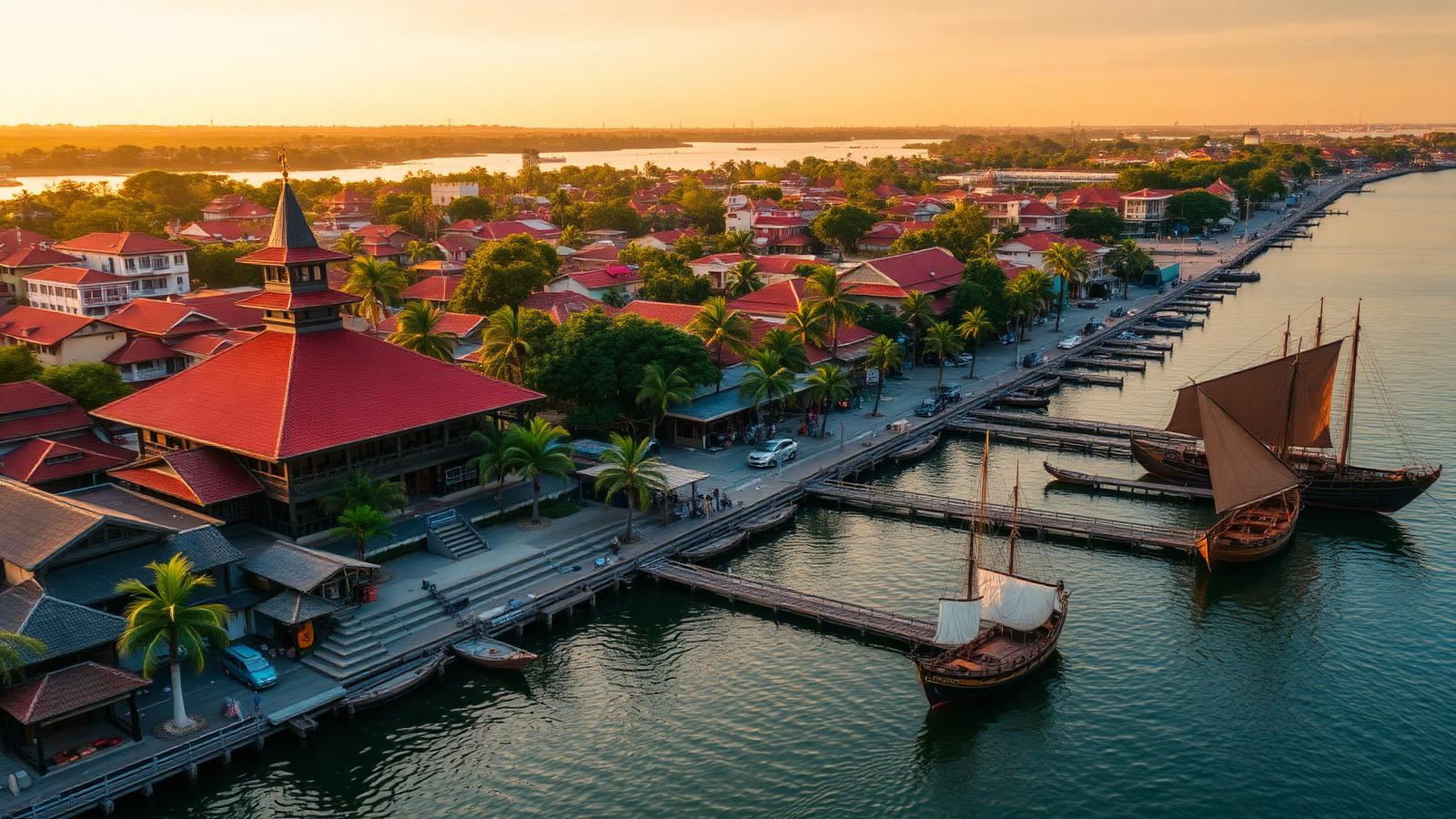
How Islam arrived in Malaysia: trade, da'wa and the Sultanate of Malacca
History of the Islamization of the Malay Peninsula (13th-15th centuries): Indian and Arab trade routes, the decisive role of the Sultanate of Malacca, and the spread of Shafi'i Sunni Islam through commerce and da'wa.
L'équipe Muslim Map
Guides halal & voyages musulmans · Mis à jour le 7/15/2026
How Islam arrived in Malaysia: trade, da'wa and the Sultanate of Malacca
🕌 Islam is now the religion of more than 60% of Malaysians, and Shafi'i Sunni Islam has been the norm there for centuries. But how did a religion born in Arabia take such deep root in the Malay Peninsula, at the far end of the Indian Ocean? The answer comes down to two words: trade and da'wa.
A maritime crossroads before Islam
Long before Muslims arrived, the Malay Peninsula and the Indonesian archipelago were already one of the great crossroads of world trade. Spices, gold, tin, camphor, precious woods: Malay ports connected China, India, Persia and the Arab world.
This strategic position explains why the region was touched very early by the great religions that came from India (Hinduism, Buddhism), and then by Islam once Muslim merchants became dominant on the maritime routes of the Indian Ocean.
Trade routes: the true vector of Islamization
From the 8th century onward, Arab and Persian merchants, then Muslims from the Indian subcontinent (Gujarat, Malabar, Coromandel, Bengal), sailed across the Indian Ocean. They gradually settled in the ports of Southeast Asia.
Three historical facts are well established:
- The first Muslims present in the region were above all foreign merchants, settled in port trading posts.
- The real Islamization of the local population began mainly from the 13th century, when local rulers converted.
- The main vectors were merchants and preachers (du'āt) who accompanied them or settled locally.
💡 Contrary to a persistent cliché, Islam was not imposed by conquest in Malaysia. It spread through trade, marriages, the example of Muslim merchants and direct teaching of the religion (da'wa).
The 13th century: the first attested conversions
The first clear trace of Muslim political power in the region is found in Pasai (northern Sumatra), at the end of the 13th century. The tombstone of Sultan Malik as-Salih, who died in 1297, is one of the oldest documents attesting to a Muslim ruler in the Malay world.
Marco Polo, passing through in 1292, already noted that the town of Perlak, near Pasai, was Muslim, while the surrounding areas were not yet so. Here we see the typical pattern of diffusion: ports first, the interior afterward.
Malacca (15th century): the decisive turning point for the peninsula
The founding event for present-day Malaysia was the establishment of the Sultanate of Malacca at the very beginning of the 15th century by Parameswara, a refugee prince from Sumatra.
- Around 1400: foundation of the trading post of Malacca.
- Shortly afterward: conversion of the ruler to Islam and adoption of the title of sultan (Iskandar Shah).
- 15th century: Malacca became one of the richest ports in Asia, an essential stop between China, India and the Arab world.
This princely conversion had a chain effect:
- Malay elites adopted Islam through political imitation and because the faith of the merchants was also that of the ruler.
- Malacca attracted even more Muslim merchants, strengthening the economic weight of Islam.
- Scholars (
ulamā') from Arabia, Yemen, India and Persia settled there, trained students, produced works in Malay and established the religious norm. - From Malacca, Islam spread to the other sultanates of the peninsula: Kedah, Perak, Pahang, Johor, Kelantan, Terengganu.
When the Portuguese captured Malacca in 1511, the Islamization of the peninsula was already largely complete; their conquest only accelerated the dispersal of Muslim scholars toward other sultanates, which in turn became relays of da'wa.
Why the Shafi'i school?
The Malay world did not inherit Islam “in general”: it inherited a specific legal school, the Shafi'i madhhab, named after Imam Muhammad ibn Idris ash-Shafi'i (d. 820).
This is explained simply by the geography of trade:
- The Muslim merchants who frequented the region came mainly from Yemen, Hadhramaut, South India (Malabar, Coromandel) and Gujarat.
- These regions had been predominantly Shafi'i for centuries.
- The scholars they sent naturally taught this school in the mosques and schools (
pondok,pesantren) they founded.
As a result, by the 15th century, Shafi'i Sunnism had become the norm throughout the Malay Peninsula, Indonesia, Brunei and the southern Philippines. That remains the case today.
Da'wa, marriages and daily life
Islamization was not the result of a few spectacular conversions. It took place in ordinary life:
- Mixed marriages between Muslim merchants and local women: children were raised in Islam.
- Da'wa: literate merchants and
ulamā'explained the faith, taught the Qur'an and trained the first local imams. - Gradual adoption of rites: daily prayer, Ramadan fasting, dietary laws (halal), circumcision, Muslim funerals.
- Elites first, people afterward: royal courts adopted Arabic titulature, the Hijri calendar and Islamic law; the rest of society followed.
It was therefore an Islam of merchants and preachers, transmitted by speech, writing and example, far more than by force.
What to remember
| Period | Key event |
|---|---|
| 8th-12th century | Presence of Muslim merchants in the region's ports |
| Late 13th century | First attested Muslim sultanate: Pasai (Sumatra) |
| Around 1400 | Foundation of the Sultanate of Malacca |
| 15th century | Islamization of the sultanates of the Malay Peninsula |
| 1511 | Fall of Malacca: Muslim scholars spread outward |
Islam therefore arrived in Malaysia by sea, through trade and through da'wa, carried by merchants and scholars from Arabia, Yemen and India. The Sultanate of Malacca played the role of catalyst by making Islam the religion of the elites, then of an entire people, within a Shafi'i rite that is still alive today.
FAQ
When did Islam arrive in Malaysia? The first Muslim merchants frequented the region as early as the 8th-9th centuries, but the Islamization of the population began mainly in the 13th century and accelerated with the foundation of the Sultanate of Malacca around 1400.
Which rite is followed in Malaysia? Shafi'i Sunni Islam, transmitted by merchants and scholars from Yemen, Hadhramaut and South India, who were themselves Shafi'i.
Was Islam imposed by conquest?
No. In Malaysia, Islam spread through maritime trade, the da'wa of merchants and ulamā', mixed marriages and the conversion of local rulers, beginning with those of Malacca.
What was the role of the Sultanate of Malacca? Malacca was the major relay of Islamization in the peninsula: as Southeast Asia's richest port in the 15th century, it attracted Muslim merchants and scholars, converted local elites and spread Islam to all neighboring sultanates.
Muslim Map
🕌 Trouvez des adresses halal près de vous
Explorez la carte, filtrez par certification et découvrez les avis de la communauté.