

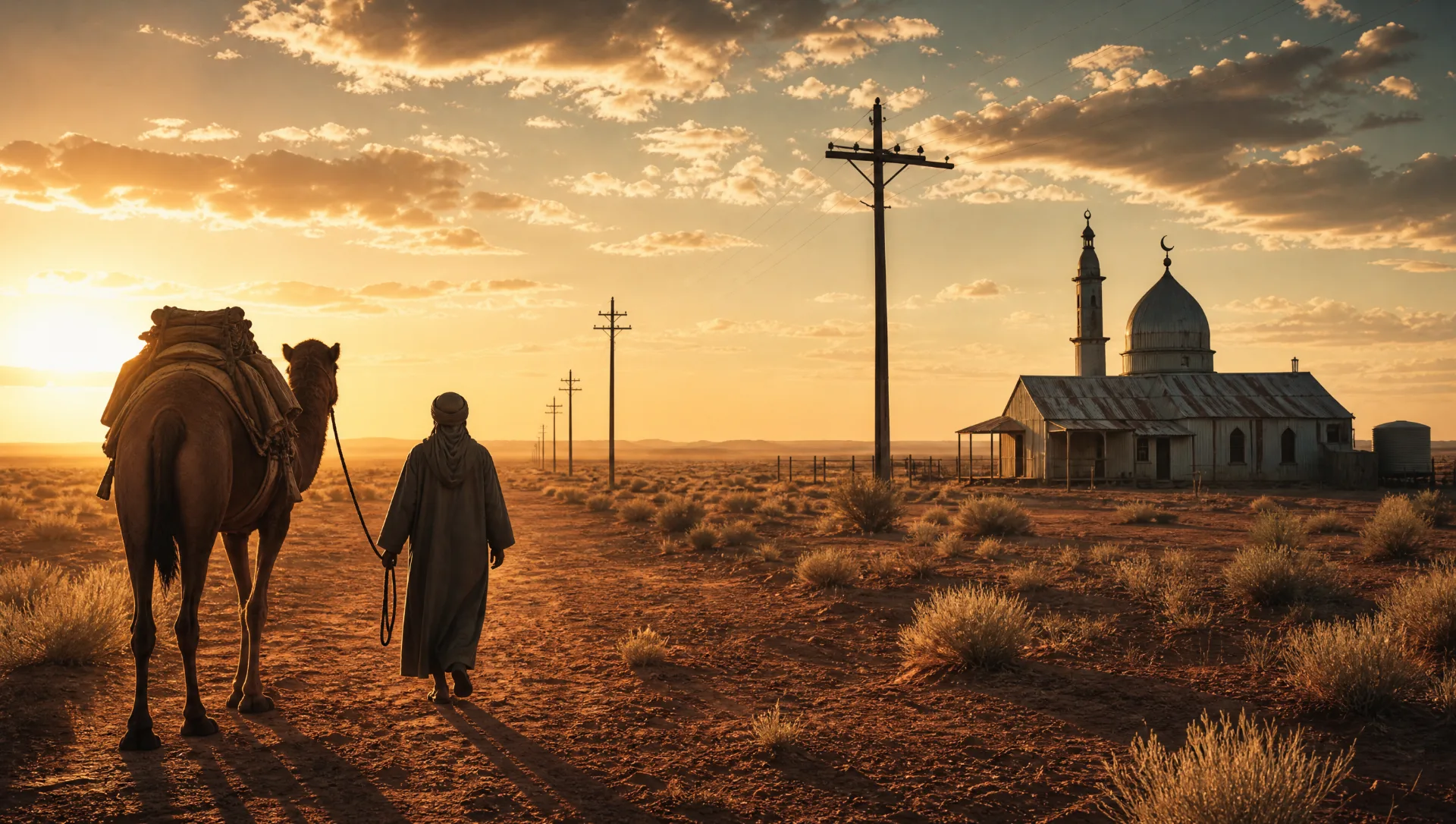
The history of Islam in Australia: from cameleers to the present day
Discover the fascinating history of Islam in Australia, from the arrival of Afghan cameleers in the 19th century to the vibrant communities of today. A rigorous historical account of building a multicultural Muslim presence in the heart of the Outback and major cities.
L'équipe Muslim Map
Guides halal & voyages musulmans · Mis à jour le 7/18/2026
When we think of Australia's history, we rarely think of the crucial contribution of Muslims to the exploration of its territory. Yet, long before the waves of European immigration in the 20th century, it was Muslim pioneers who opened up communication routes across the Australian desert.
Here is the historical account of a community whose roots have been deeply anchored in Australian soil for over 160 years.
🐪 Pioneers of the Outback: The Epic of the Afghan Cameleers
In the 1860s, Australia faced an immense challenge: exploring and mapping its desert center, the Outback. The horses and oxen of the British settlers died of thirst and exhaustion in the face of extreme weather conditions.
To overcome this obstacle, the authorities decided to import camels and recruit experienced handlers. This was the beginning of the epic of the Afghan cameleers.
Although generally referred to as "Afghans", these pioneers actually came from regions corresponding today to Afghanistan, present-day Pakistan (notably Balochistan and Punjab), and Northern India. They were predominantly of the Sunni Muslim faith.
Between 1870 and 1920, around 3,000 Muslim cameleers settled temporarily or permanently in Australia. They played a key role in the construction of the Overland Telegraph Line and the railway linking the south to the north of the country.
The First Desert Mosques
To practice their faith, these men built modest structures of corrugated iron and salvaged wood in the inland garrison towns, such as Hergott Springs (now Marree).
In 1888, the first major permanent urban mosque was erected in Adelaide, centralizing the spiritual life of believers in the region.
The Adelaide Mosque (Central Adelaide Mosque)
- 📅 Year of construction: 1888 (the minarets were added in 1903)
- 📌 Significance: Oldest urban mosque still active in Australia.
- 📍 Address: 20 Little Gilbert St, Adelaide, Australia.
📈 Chronology of Muslim Presence in Australia
The history of the Muslim community was built in several distinct stages, marked by the evolution of the country's migration policies:
- 1860: Arrival of the first three contracted cameleers for the Burke and Wills expedition.
- 1888: Inauguration of the Adelaide Mosque, funded by donations from the cameleers.
- 1901: Introduction of the "White Australia Policy", which drastically curbed non-European immigration and forced many cameleers to leave.
- 1960 - 1970: Arrival of the first significant waves of Muslim immigration from Turkey and Lebanon to meet industrial labor needs.
- 1973: Definitive abolition of the restrictive White Australia Policy, opening the way for multicultural immigration.
🔄 From the Outback to the Cities: Modern Immigration
The demographic landscape of Australian Islam changed radically after World War II. With the decline of camel transport (replaced by trucks and trains), the descendants of the cameleers assimilated or returned to their countries of origin.
From the 1960s onwards, new faces began to shape the Muslim community:
- 🇹🇷 The Turkish community: Following a bilateral agreement signed in 1967, thousands of Turkish families settled in the industrial suburbs of Melbourne and Sydney.
- 🇱🇧 The Lebanese community: Fleeing the civil war starting in 1975, many Lebanese of Sunni faith settled mainly in western Sydney (notably in the suburb of Lakemba).
This immigration transformed Australian Islam from a rural and nomadic religion into a vibrant, urban, and deeply multicultural faith.
| Period | Main Profile | Primary Role / Status | Settlement Areas |
|---|---|---|---|
| 1860 - 1920 | South Asian cameleers | Transport, Outback exploration | Arid zones, Marree, Adelaide |
| 1960 - 1980 | Middle Eastern immigrants (Lebanon, Turkey) | Industrial workers, reconstruction | Suburbs of Sydney and Melbourne |
| 2000 - Present | Global diversity (Asia, Middle East, Africa) | Professionals, students, merchants | Major national cities |
🕌 The Australian Muslim Community Today
According to the 2021 national census, Muslims now make up 3.2% of Australia's total population, or approximately 813,000 people.
This community is characterized by immense ethnic and cultural diversity. Over 120 countries of origin are represented, with the largest groups originating from Lebanon, Turkey, Afghanistan, Pakistan, Bangladesh, and Indonesia.
Local institutions, such as the Australian National Imams Council (ANIC), structure religious practice according to traditional Sunni theology, managing mosques, private Islamic schools, and the halal certification necessary for the daily life of believers.
FAQ
Who were the "Ghans" really?
The "Ghans" was the nickname given by Australian settlers to the cameleers. Although many came from the border regions of present-day Pakistan or Northern India, the term referred to their perceived Afghan origin.
What is the connection between the cameleers and the legendary train "The Ghan"?
The famous passenger train that crosses Australia from south to north (from Adelaide to Darwin) is called The Ghan. This name was chosen in tribute to the Afghan camel caravans that previously provided the only possible connection across this formidable desert.
Where is the oldest standing mosque in Australia?
The oldest mosque still standing on Australian soil is the Marree Mosque, built of mud and iron around 1882 in northern South Australia. It has been restored for historical purposes, while the Adelaide Mosque (1888) remains the oldest continuously operating urban mosque.
Muslim Map
🕌 Trouvez des adresses halal près de vous
Explorez la carte, filtrez par certification et découvrez les avis de la communauté.