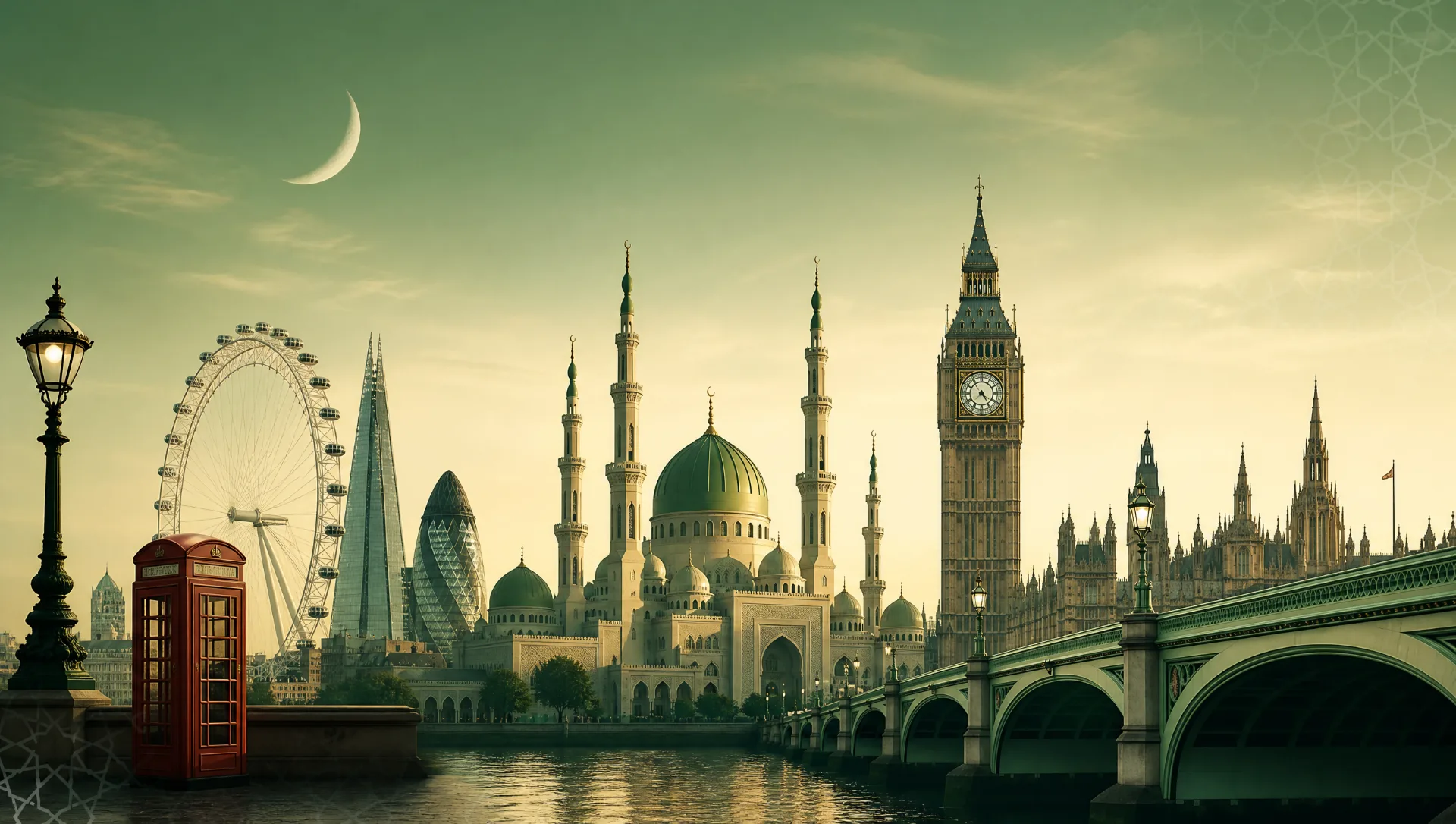
Islam in London: The City of 400 Mosques
With around 400 mosques and one of the largest Muslim communities in Europe, discover London's deeply Sunni Islam, structured around its masājid, schools, and neighborhood associations.
L'équipe Muslim Map
Guides halal & voyages musulmans · Mis à jour le 7/16/2026
Islam in London: The City of 400 Mosques
🇬🇧 With nearly 400 registered mosques and over one million Muslims, London is today one of the most vibrant Muslim capitals in Europe. A majority Sunni Islam, diverse in its origins but united in its fundamentals: salāt, jumu'ah, Quranic schools, and neighborhood associations.
A Multi-generational Community
Islam in London is nothing new. The first Muslim presence dates back to the 19th century (Yemeni sailors, Indian students, Ottoman diplomats). However, the community truly began to structure itself from the 1960s-70s with the mass arrival of families from the Indian subcontinent (Pakistan, Bangladesh, India), followed later by Arabs (Gulf, Levant, North Africa), Somalis, Turks, and, more recently, British converts.
In 2026, the number of Muslims in London is estimated at just over one million — representing about 15% of the metropolis's population, with some boroughs exceeding 40% (Tower Hamlets, Newham, Redbridge).
Around 400 Mosques: What You Need to Know
The figure of 400 mosques circulates in municipal and community reports. It includes:
- Major historic mosques: East London Mosque (Whitechapel), London Central Mosque (Regent's Park), Finsbury Park Mosque, Baitul Futuh (Morden), Harrow Central Mosque.
- Neighborhood masājid housed in former Victorian houses, warehouses, schools, or converted commercial premises.
- Prayer rooms in universities, hospitals, and airports.
💡 Most of these mosques are Sunni, without exclusive labels: they follow the main lines of classical fiqh (Hanafi, Shafi'i, Maliki, or Hanbali depending on the origin of the community that frequents them).
The Main Communities of Origin
🇧🇩 The Bangladeshi Community
Concentrated mainly in Tower Hamlets (Whitechapel, Bethnal Green, Stepney), this is historically one of the most visible. It built the famous East London Mosque, capable of accommodating over 7,000 worshippers for jumu'ah. Street food, halal grocery stores, evening Quranic schools: Brick Lane and its surroundings remain a beating heart of this community, which is predominantly of the Hanafi school.
🇵🇰 The Pakistani Community
Present in Ilford, Redbridge, Walthamstow, Newham, often originating from Kashmir and Punjab. It has founded numerous neighborhood mosques, memorization schools (ḥifẓ), and religious education centers. Dominant school: Hanafi, with a strong tradition of scholars trained in the major universities of the subcontinent.
🌍 The Arab Community
Settled mainly in West London (Bayswater, Edgware Road, Knightsbridge), and more recently in the northwest. A cosmopolitan community: Gulf, Egypt, Syria, Lebanon, Morocco, Algeria, Yemen. Dominant school: Shafi'i or Maliki depending on the countries of origin, with a significant student presence.
🇸🇴 The Somali Community
Arrived in large numbers in the 1990s-2000s (Woolwich, Southall, Camden, Ealing). A young community, highly attached to the neighborhood mosque and evening school. Dominant school: Shafi'i, with a strong practice of classical Arabic and Quran memorization.
🇹🇷 The Turkish Community
Concentrated in North London (Green Lanes, Dalston, Enfield). It built the spectacular Suleymaniye Mosque in Hackney. School: Hanafi, with a classic Ottoman organization (diyanet, evening schools, cultural associations).
How is London's Islam Organized?
Unlike in other capitals, there is no centralized religious authority in England. The organization is community-based, decentralized, and charity-run:
- Each mosque is managed by a board of trustees (committee of worshippers), registered as a charity with the Charity Commission.
- Imams are recruited either locally (trained in the UK, at Al-Azhar, or in Medina) or seconded from their countries of origin.
- Major federations — Muslim Council of Britain (MCB), British Muslim Forum, Islamic Cultural Centre — coordinate public stances, representation, and education, without issuing binding fatwas.
- Independent Muslim schools and evening madāris welcome tens of thousands of children every week.
📚 The result: a deeply Sunni fabric, highly classical in its fiqh, yet very flexible in its organization.
Ramadan in London
Since the 2010s, the Mayor of London has funded Ramadan light decorations in Piccadilly, Coventry Street, and Leicester Square. Thousands of worshippers gather in Trafalgar Square for the opening iftar. Major mosques organize massive tarāwīḥ prayers, often with guest reciters from around the world. Hundreds of halal restaurants remain open after maghrib, with night markets in Whitechapel, Southall, and Green Street.
Education and Transmission
- Several dozen independent Muslim schools recognized by Ofsted.
- Evening madāris in almost every neighborhood mosque.
- Higher education institutes: Al-Salam Institute, Cambridge Muslim College, Ebrahim College.
- University chairs in Islamic studies (SOAS, King's College, Cambridge).
Result: a generation of young Muslims born in London, often trilingual, comfortable in both British culture and ʿulūm al-sharīʿah.
Halal and Daily Life
London is one of the easiest cities in the world to live halal: thousands of restaurants, halal aisles in almost every supermarket, neighborhood butcher shops, Islamic banks (Al Rayan Bank, Gatehouse Bank), and mosques open for the five daily prayers.
Contemporary Challenges
- Islamophobia and anti-Muslim incidents, on the rise according to Tell MAMA.
- Social deprivation in certain neighborhoods.
- Generational divide: preserving religious transmission among acculturated youth.
- Media representation often reduced to a few controversial figures.
Despite everything, London's Islam is today confident, structured, and solidly Sunni — neither radical nor folkloric, simply classical.
FAQ
How many Muslims are in London in 2026?
Around 1 to 1.1 million, representing about 15% of the population of Greater London.
What is the largest mosque in London?
The East London Mosque (Whitechapel) and the London Central Mosque (Regent's Park) are the most iconic.
Is London's Islam predominantly Sunni?
Yes, overwhelmingly so, distributed among the four classical madhāhib.
Is it easy to live halal in London?
Yes: halal restaurants are everywhere, supermarkets have dedicated halal sections, there are neighborhood butchers, and mosques are open throughout the day.
Muslim Map
🕌 Trouvez des adresses halal près de vous
Explorez la carte, filtrez par certification et découvrez les avis de la communauté.