
Islam in Pakistan: From the Indus Valley to the Creation of the State
Discover the history of Islam in Pakistan, from the expedition of Muhammad ibn Qasim in Sindh in 712 to the founding of the first modern Islamic Republic in 1947.
L'équipe Muslim Map
Guides halal & voyages musulmans · Mis à jour le 7/27/2026
Modern Pakistan possesses a religious and political identity deeply rooted in the history of South Asia. From the arrival of the first Muslims in the Indus Valley in the 8th century to the proclamation of independence in 1947, the vision of a nation for the region's Muslims took shape through centuries of cultural, spiritual, and geopolitical transformations.
Here is the historical account of a major transition, linking the Umayyad conquest to the birth of the Pakistani state.
712: The Expedition of Muhammad ibn Qasim and the Gateway of Islam
The history of Islam in the Indian subcontinent officially begins in 712. Under the Umayyad caliphate of Al-Walid I, the young general Muhammad ibn Qasim, then only 17 years old, was sent to lead a military campaign in the region of Sindh (present-day southern Pakistan).
This expedition followed repeated attacks by Sindh-based pirates against Muslim merchant ships. Ibn Qasim's rapid victory integrated the Indus Valley into the Islamic world. Sindh then received the historic title of Bab-ul-Islam (the Gateway of Islam).
Contrary to popular belief, the conversion of the local population occurred gradually over several centuries, facilitated by peace treaties guaranteeing freedom of worship to the local Hindu and Buddhist populations, who were then assimilated into the status of dhimmis.
Centuries of Consolidation: From the Ghaznavids to the Mughals
After this initial establishment, Islamic influence expanded northward starting in the 11th century under the impetus of the Ghaznavid dynasty, which made Lahore a major cultural center of Persianized Islam.
Subsequently, the Delhi Sultanate (1206–1526) and then the Mughal Empire (1526–1857) unified vast territories of South Asia. It was during this prosperous period that architecture, calligraphy, Islamic jurisprudence (notably through the compilation of the Fatawa 'Alamgiri under Emperor Aurangzeb), and the Urdu language flourished.
The 20th Century and the Two-Nation Theory
After the fall of the Mughal Empire in 1857 and the establishment of the British Raj, the Muslims of India transitioned from the status of rulers to that of a political minority (about 25% of the total population of the Indian Empire).
Faced with the prospect of a future independence dominated by the Hindu majority, Muslim intellectuals began to theorize the need for distinct political representation. This marked the birth of the Two-Nation Theory, formulated by Sir Syed Ahmed Khan.
This theory posits that the Muslims and Hindus of India do not simply form two religious communities, but two distinct nations possessing different cultures, values, and aspirations.
In 1930, the poet and philosopher Allama Muhammad Iqbal formalized the idea of a sovereign Muslim state in northwestern India during his famous Allahabad Address. Today, he is considered the spiritual thinker of Pakistan.
Chronology: From Sindh to the Founding of the State
- 712: Conquest of Sindh by Muhammad ibn Qasim.
- 1021: Lahore becomes the capital of the Ghaznavid province east of the Indus.
- 1526: Founding of the Mughal Empire by Babur.
- 1906: Founding of the Muslim League in Dacca to defend the interests of India's Muslims.
- 1940: Adoption of the Lahore Resolution, demanding independent states for the Muslims of South Asia.
- August 14, 1947: Proclamation of the independence of Pakistan.
Historical Comparison of the Muslim Presence
| Criterion | Medieval Period (8th - 16th c.) | Modern Period (Post-1947) |
|---|---|---|
| Political Status | Regional Dynasties / Sultanates | Sovereign Islamic Republic |
| Demographics | Expanding minority in Sindh | 96% of the national population |
| Administrative Language | Persian / Arabic | Urdu / English |
| Legal Framework | Classical Fiqh applied locally | Constitution incorporating Sharia |
1947: The Birth of Pakistan
Under the leadership of Muhammad Ali Jinnah, revered as Quaid-e-Azam (the Great Leader), the Muslim League led intense negotiations with the British Crown and the Indian National Congress.
On August 14, 1947 (the 27th day of the month of Ramadan 1366), the partition of India became effective. Pakistan was born as a sovereign state, then divided into two wings (West Pakistan, present-day Pakistan, and East Pakistan, which became Bangladesh in 1971).
The country's name, coined in 1933 by the student Choudhry Rahmat Ali, is an acronym representing the regions of origin: Punjab, Afghania, Kashmir, Sindh, and Baluchistan. In Urdu, the word also means "land of the pure" (pak meaning pure).
Pakistan is historically the first state of the modern era to have been created specifically in the name of Islamic identity, setting a unique precedent in the history of contemporary nations.
FAQ
Who invented the concept of Pakistan?
The ideological concept was theorized by the poet Allama Muhammad Iqbal in 1930, while the exact name was proposed by a student of Punjabi origin at Cambridge, Choudhry Rahmat Ali, in 1933.
What role did Muhammad Ali Jinnah play?
A lawyer by training, Jinnah led the political and constitutional struggle for the creation of Pakistan. Although secularly educated, he championed the need for a national homeland to protect the civil, economic, and religious rights of South Asian Muslims.
What is the meaning of the Pakistani flag?
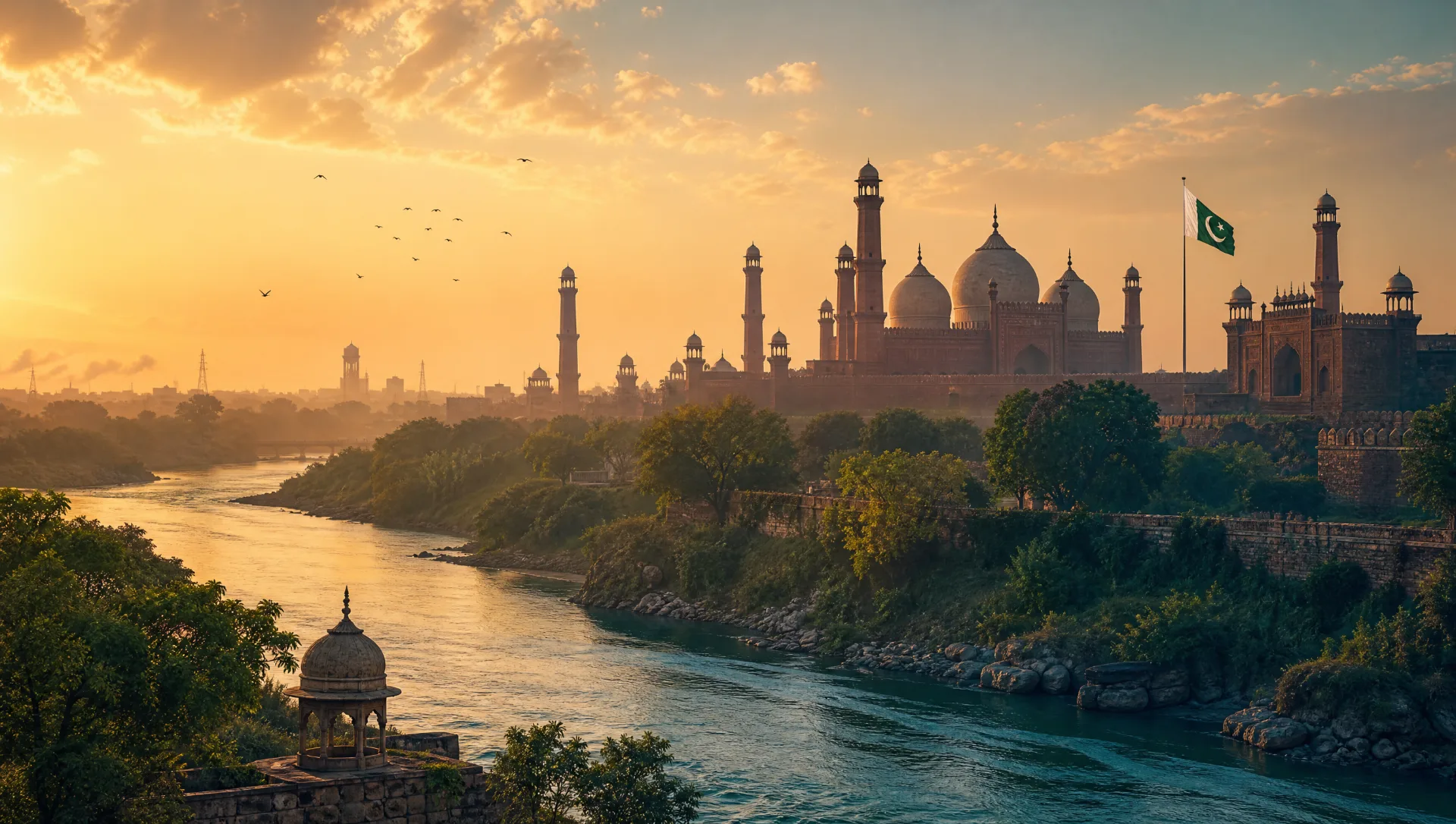
The green represents the country's Muslim majority, while the vertical white stripe represents religious minorities (Christians, Hindus, Sikhs). The crescent and star are traditional symbols of progress and light.
Muslim Map
🕌 Trouvez des adresses halal près de vous
Explorez la carte, filtrez par certification et découvrez les avis de la communauté.