Islam in Sydney: Cultural Diversity and Daily Challenges
Discover the rich and contrasting reality of the Muslim community in Sydney. From the historical influence of Lebanese, Turkish, and Afghan diasporas to the practical challenges of social integration, education, and employment, dive into the heart of Australian Islam.
L'équipe Muslim Map
Guides halal & voyages musulmans · Mis à jour le 7/24/2026
Sydney, Australia's largest metropolis, is home to a vibrant, resilient, and growing Muslim community. Representing approximately 3% of the national population, Sydney's Muslims form a true cultural mosaic.
From the historical influence of Afghan pioneers to the establishment of major institutions by waves of Lebanese and Turkish immigration, religious and social life is actively organized in this Southern Hemisphere metropolis, despite very real integration challenges.
A Unique Cultural Mosaic
Sydney's Muslim community is not a homogeneous block, but a blend of successive cultures and migration histories. Religious practice is predominantly Sunni, structured around values of solidarity and community mutual aid.
The Founding Waves of Migration
The contemporary history of Islam in Sydney has been built through successive waves. Post-war immigration agreements and geopolitical crises have deeply reshaped local demographics:
- The Lebanese community: Arriving in large numbers from the 1970s onwards, particularly due to the civil war in Lebanon. Today, it forms the historical and most influential core of Muslim institutions in Western Sydney.
- The Turkish community: Established mainly in the 1970s and 1980s through labor agreements. It has greatly contributed to the city's religious architecture.
- The Afghan community: Composed of descendants of the first 19th-century camel drivers and refugees who arrived more recently since the 2000s.
Australia's first Muslims did not come from modern migrations, but were camel drivers who arrived from Afghanistan and present-day Pakistan in the 19th century. They played a crucial role in exploring and building the infrastructure of the Australian Outback.
Distribution and Local Dynamics
| Community of Origin | Main Period of Arrival | Concentration Area | Key Landmark or Institution |
|---|---|---|---|
| Lebanese | 1970s - 1980s | Lakemba, Punchbowl | Lebanese Muslims Association (LMA) |
| Turkish | 1970s - 1990s | Auburn | Auburn Gallipoli Mosque (Ottoman style) |
| Afghan | 19th century & 2000s | Blacktown, Merrylands | Blacktown Mosque and support centers |
Lakemba Mosque: The Beating Heart of the Community
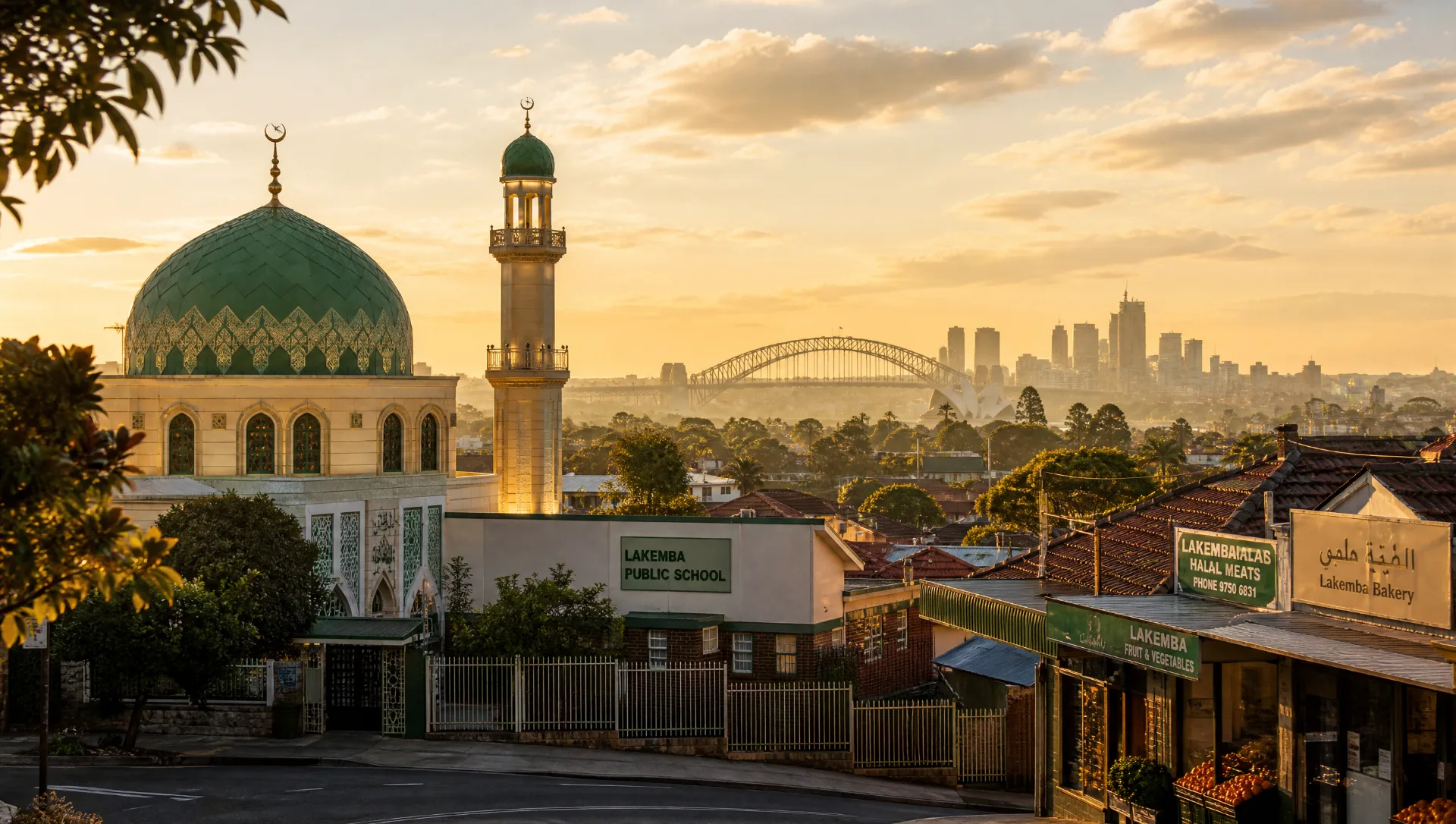
Located in Sydney's western suburbs, Lakemba Mosque (officially named Masjid Ali Bin Abi Talib) is the most famous and busiest in the country. Managed by the Lebanese Muslims Association (LMA), it goes far beyond its simple function as a place of worship.
Lakemba Mosque (Masjid Ali Bin Abi Talib)
- Address: 65-67 Wangee Rd, Lakemba NSW 2195, Australia
- Access: Train (T3 Line, Lakemba station a 10-minute walk)
- Management: Lebanese Muslims Association (LMA)
- Capacity: Over 10,000 worshippers during major gatherings.
It serves as a social resource center, support for newcomers, and a platform for interfaith exchange. During the month of Ramadan, the surrounding neighborhood transforms to host a night market famous throughout the city.
If you visit Sydney during the month of Ramadan, the Lakemba street festival (Haldon Street) is an unforgettable experience. It is one of the largest halal street food gatherings in the region, attracting tens of thousands of visitors of all faiths.
Practical Integration Challenges in Sydney
Despite official multiculturalism promoted by the Australian government, Sydney's Muslims face complex daily challenges in balancing their religious practice with full participation in civic life.
Access to Employment and Professional Recognition
Professional integration remains a sensitive issue. Many qualified Muslims from recent immigration waves face difficulties in getting their foreign qualifications recognized.
Furthermore, local studies regularly highlight unconscious bias during recruitment processes for candidates with Arabic-sounding names or for women wearing the hijab.
Education and Schooling
To preserve their children's religious identity while ensuring academic excellence, many families turn to private Islamic schools.
These institutions, such as the Malek Fahd Islamic School, strictly follow the official New South Wales state curriculum while integrating Islamic ethics and Arabic language classes. The major challenge remains funding and managing the rapid growth in student numbers at these schools.
Public Perception and the Media
Sydney's Muslim community has sometimes suffered from polarizing media coverage, particularly following global security events or local tensions such as the Cronulla riots in 2005.
Since then, in-depth work has been carried out by associations to open mosques to the general public and multiply civic dialogue initiatives to break down prejudices.
FAQ on Muslim Life in Sydney
Is it easy to find halal food in Sydney?
Yes, it is extremely simple, especially in the city's western suburbs (Western Sydney) such as Lakemba, Auburn, Bankstown, and Granville. Halal butcher shops, restaurants, and supermarkets are ubiquitous there. Most major supermarket chains also offer dedicated sections.
How is religious education organized for children?
Outside of full-time private Islamic schools, the majority of Sydney's mosques offer weekend classes (Madrasah) for learning the Quran and the basic principles of the Sunni faith.
What is the social climate for women wearing the veil in Sydney?
Sydney is generally a modern, cosmopolitan, and safe city. In the Western Sydney neighborhoods, wearing the hijab is completely normalized. Although isolated incidents may occur, Australian police and judicial institutions take reports of discrimination or Islamophobia very seriously.
Key Takeaways to Understand Islam in Sydney
- Rich diversity: A community driven by waves of Lebanese, Turkish, and Afghan immigration.
- Strong institutions: Major infrastructure such as the Lakemba Mosque and a structured network of Islamic schools.
- Active citizenship: A strong commitment from associations to overcome employment barriers and foster intercultural dialogue.
Muslim Map
🕌 Trouvez des adresses halal près de vous
Explorez la carte, filtrez par certification et découvrez les avis de la communauté.