

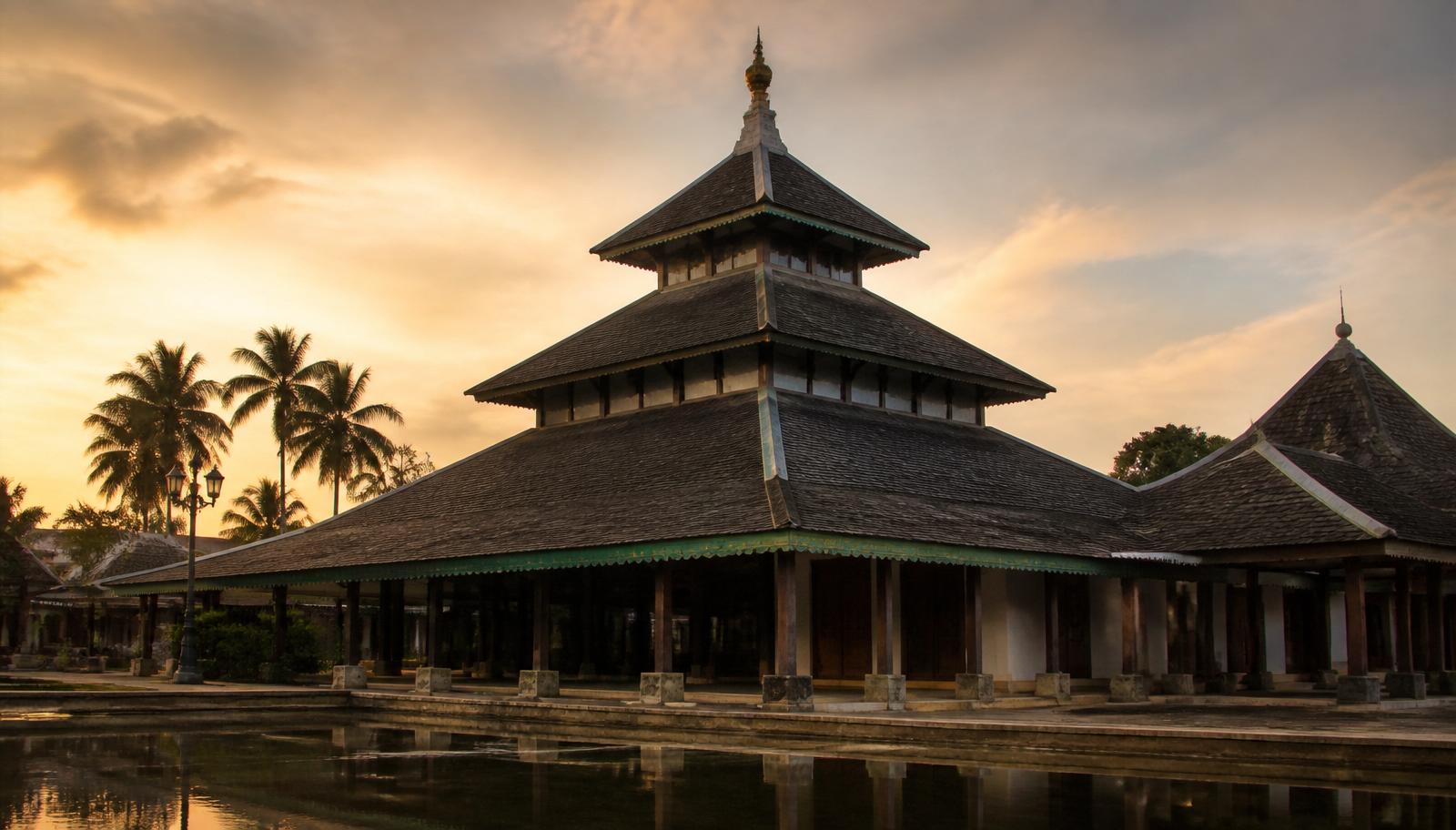
The Islamisation of the Indonesian Archipelago: Between Trade and Da'wa
From Sumatra to Java, how Islam spread across the Indonesian archipelago from the 7th to the 16th century through Arab and Indian merchants, and then the preaching of the Wali Songo.
L'équipe Muslim Map
Guides halal & voyages musulmans · Mis à jour le 7/15/2026
An Archipelago at the Crossroads of Maritime Routes
Before the arrival of Islam, the Indonesian archipelago (Nusantara) was a major commercial crossroads between India, China, and the Arab world. Its ports — Barus, Palembang, and later Malacca — had for centuries welcomed merchants from all over the Indian Ocean. Spices, camphor, gold, and silk passed through them, making the region one of the economic engines of medieval Asia.
It was through these routes that Islam arrived, not by military conquest, but through trade and preaching (da'wa).
Sumatra: The First Islamic Land in Southeast Asia
The earliest traces of a Muslim presence in the archipelago date back to the 7th-8th century, with Arab merchants passing through the west coast of Sumatra, particularly at Barus, a port famous for its camphor. Chinese sources from the Tang dynasty mention communities of Arab merchants (referred to as Ta-shih) settled in the region as early as this period.
But it was in the 13th century that the first Islamic sultanate in the archipelago was documented: the Sultanate of Samudera Pasai, on the northern coast of Sumatra (present-day Aceh province). The travelogue of the Moroccan traveler Ibn Battuta, who stayed there in 1345-1346, describes a ruler, Sultan Al-Malik Al-Zahir, as a pious Muslim of the Shafi'i school, surrounded by scholars and a fervent advocate of da'wa to neighboring regions that were not yet Muslim.
The tombstone of Sultana Malikah Nahrasiyah (1428) in Pasai, engraved in Arabic, bears witness to the influence of this first Islamic center, which would spread towards the Malay Peninsula and western Java.
Arab and Indian Merchants: Vectors of Islam
The spread of Islam in the archipelago owes an immense amount to merchant networks:
- Arab merchants from Hadramaut (Yemen) and the Gulf, present on all major maritime routes.
- Gujarati merchants (India) who were Muslim, whose role has long been highlighted by historians such as Snouck Hurgronje.
- Persian and Bengali merchants, who were also active in the major ports.
These merchants did not just trade: they settled, married local women, formed communities, built mosques, and invited the populations to Islam through their behavior, their commercial honesty, and their teaching. The Shafi'i school, dominant in Yemen and southern India, naturally established itself throughout the archipelago — it remains the dominant madhhab in Indonesia today.
Java and the Wali Songo: The Nine Saints of Da'wa
While Sumatra was the gateway, it was Java — the most populous island — that would become the demographic heart of Indonesian Islam. Tradition attributes this Islamisation to a group of nine preachers called the Wali Songo ("the nine walis", the nine saints), active between the 15th and 16th centuries.
The names most frequently cited are:
- Sunan Gresik (Maulana Malik Ibrahim, died 1419), considered the pioneer, probably of Persian or Arab origin, active on the northeastern coast of Java.
- Sunan Ampel (Raden Rahmat), his nephew, who trained a generation of preachers in Surabaya.
- Sunan Bonang, Sunan Drajat, Sunan Kudus, Sunan Muria, Sunan Giri, Sunan Kalijaga, and Sunan Gunung Jati, the latter being the founder of the Cirebon Sultanate and later conqueror of Banten.
The Wali Songo first anchored Islam in the ports of the northern coast (Pasisir), and then in the Javanese interior. They founded religious schools (pesantren), trained leaders, and laid the legal and social foundations of Islam in Java.
From Malacca to Demak: The Political Shift
In the 15th century, the Sultanate of Malacca (Malay Peninsula, founded around 1400) became the major commercial and religious hub of the region. Its conversion to Islam at the beginning of the century and its wealth made it a center of influence spreading towards Java, Borneo, and the Moluccas.
In 1478, the Sultanate of Demak was founded on the northern coast of Java, marking the end of the last great Hindu-Buddhist kingdom of Java, Majapahit. Demak, supported by the Wali Songo, would extend its influence across the entire island, and then towards Banten (west) and Cirebon. The Great Mosque of Demak (Masjid Agung Demak), built at the end of the 15th century, remains one of the oldest Islamic monuments in the country.
In the 16th century, Islam also progressed towards Sulawesi (the sultanates of Gowa and Ternate), Borneo (Banjarmasin), and the Moluccas, completing the Islamisation of the archipelago.
A Note of Discernment
This history, rich and fascinating, must be read with discernment.
Certain practices locally associated with this Islamisation — notably kejawen (a syncretic spirituality blending Islam, Hinduism, Buddhism, and Javanese animist beliefs) or the veneration of graves and saints (ziarah to the graves of the Wali Songo interpreted as intercession) — do not belong to authentic Islam as transmitted by the Prophet ﷺ and his companions.
Authentic Islam is based on pure Tawhid: the absolute oneness of Allah, without intermediaries, without grave worship, and without mixing with other religions or spiritualities. Paying tribute to scholars for their work of da'wa is legitimate; invoking them, seeking their intercession, or mixing their veneration with non-Islamic rituals is not.
This article therefore presents the historical facts of the spread of Islam in the archipelago — a remarkable, peaceful, and commercial phenomenon in its nature — without validating the syncretic deviations that sometimes attached themselves to it.
Key Takeaways
- Islam arrived in Indonesia through trade and da'wa, not through war.
- Sumatra (Barus, Pasai) was the first Islamic land in the archipelago, documented as early as the 13th century.
- Arab, Gujarati, and Persian merchants carried the message along the maritime routes.
- The Wali Songo anchored Islam in Java in the 15th-16th century, making the archipelago the largest Muslim country in the world today.
- The Shafi'i school inherited from this history remains the majority school in Indonesia.
- The syncretic practices (kejawen, saint veneration) that sometimes attached themselves to this Islamisation are not part of authentic Islam and must be distinguished from the historical facts themselves.
Muslim Map
🕌 Trouvez des adresses halal près de vous
Explorez la carte, filtrez par certification et découvrez les avis de la communauté.