Islam in Berlin: At the heart of Germany's Turkish community
Discover the history and structure of the Muslim community in Berlin, the largest Turkish diaspora in Europe. This article deciphers the organization of Berlin's mosques, from the institutional DITIB to neighborhood associations, with a focus on the famous Şehitlik Mosque.
L'équipe Muslim Map
Guides halal & voyages musulmans · Mis à jour le 7/20/2026
Berlin is home to one of the most vibrant Muslim communities in Western Europe, marked by a strong historical Turkish footprint. With more than 300,000 Muslims residing in the German capital, the practice of Islam has structured itself over the decades.
Between official institutions linked to countries of origin and small neighborhood associations, Berlin's religious landscape reflects the diversity and organization of this community.
A Historical Presence Born of Immigration
The history of contemporary Islam in Berlin is closely linked to the labor recruitment agreement (Gastarbeiter) signed between the Federal Republic of Germany and Turkey in 1961. Initially arriving on temporary contracts, many workers settled permanently, particularly in the neighborhoods of Kreuzberg and Neukölln.
Over generations, these families felt the need to structure their religious practice. The first prayer spaces, often set up in backyards of residential buildings or former disused factories, gradually gave way to Ottoman-style mosques or modern cultural centers.
Today, it is estimated that the Turkish community represents the largest group within Berlin's Muslim population, followed by Arabic (especially Syrian and Lebanese) and Balkan communities.
Institutional Islam vs. Neighborhood Associations
To understand the organization of mosques in Berlin, it is helpful to distinguish between two main models: institutional Islam, largely represented by DITIB, and independent local associations.
1. Institutional Islam (DITIB)
The DITIB (Diyanet İşleri Türk İslam Birliği) is the Turkish-Islamic Union for Religious Affairs. It is the largest Muslim umbrella organization in Germany. It is directly linked to the Presidency of Religious Affairs of Turkey (Diyanet), based in Ankara.
Imams officiating in DITIB mosques are generally civil servants trained in Turkey and seconded to Germany for a period of 4 to 5 years. This model guarantees a standardized Sunni practice and structured guidance, but sometimes sparks debate in Germany regarding the political influence of the Turkish state over the diaspora.
2. Neighborhood Associations (Kiez-Moscheen)
In contrast to this centralized model, there are neighborhood associations or Kiez-Moscheen. Founded by local initiatives of worshippers, they operate independently as non-profit associations (Eingetragener Verein or e.V.).
These mosques are funded by member dues and donations. They freely choose their imam, although limited financial resources often require the use of volunteer imams.
Comparative Table of Religious Structures in Berlin
| Feature | Institutional Islam (DITIB) | Neighborhood Associations (Kiez-Moscheen) |
|---|---|---|
| Oversight / Affiliation | Linked to the Diyanet (Ankara, Turkey) | Independent, managed by local committees |
| Funding | Institutional subsidies and secondments | Local donations, member dues |
| Imam Profile | Civil servant theologians sent from Turkey | Local imams, often volunteers |
| Languages Used | Mainly Turkish, transitioning to German | Arabic, Turkish, German depending on the audience |
The Şehitlik Mosque: A Berlin Landmark
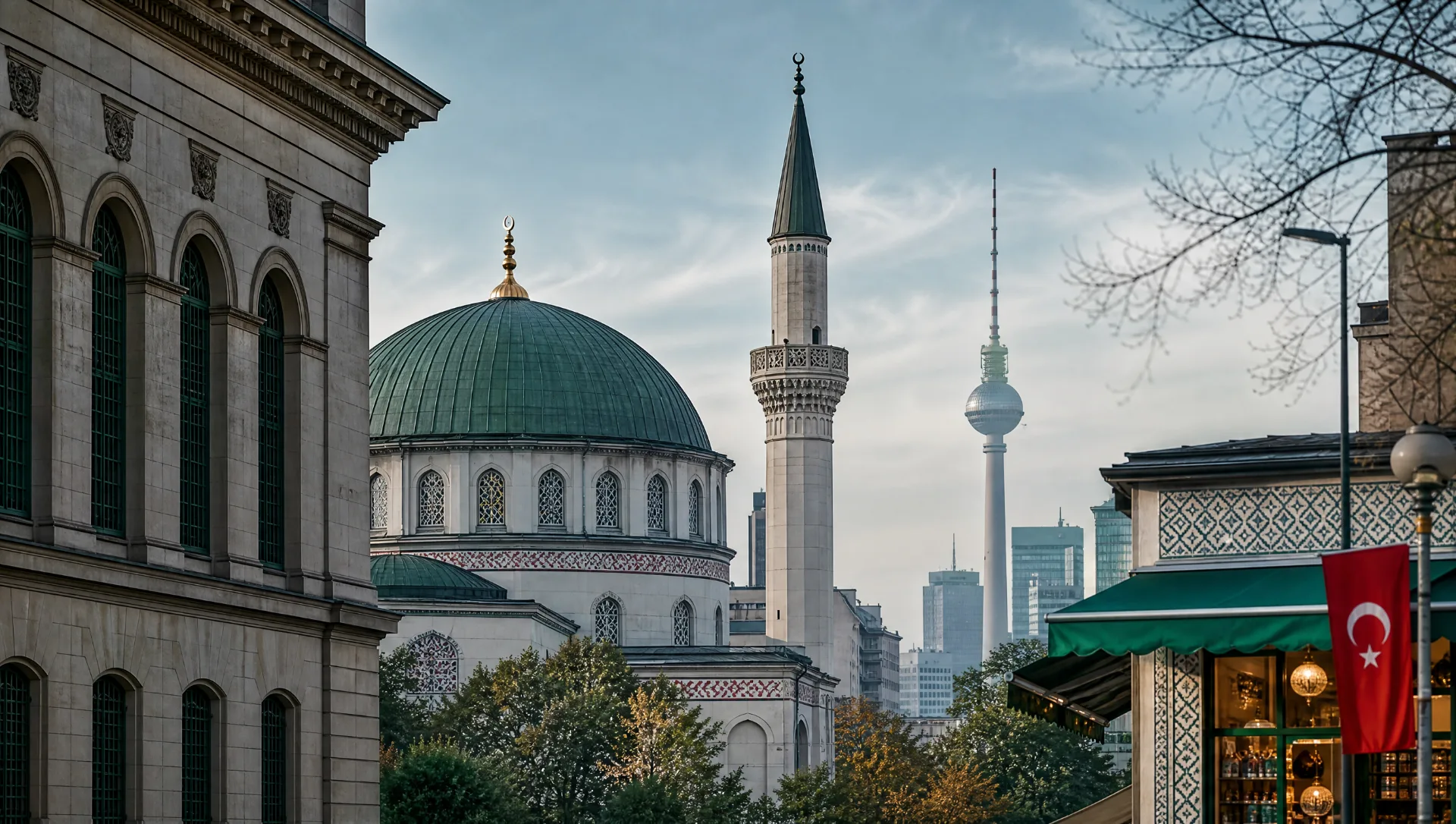
Built between 1999 and 2005, the Şehitlik Mosque (Şehitlik Camii, located on the edge of the Neukölln district) is the most visible symbol of Ottoman-inspired Islam in Berlin. Designed by architect Hilmi Şenalp, it is built on the site of a former Ottoman diplomatic cemetery dating back to the 18th century.
With its 37-meter high minarets and its main dome, it welcomes thousands of worshippers every Friday. Beyond its religious function, the Şehitlik Mosque plays a major cultural and social role, offering guided tours for the general public and integration programs.
Practical Info: Şehitlik Mosque (Şehitlik Camii)
- Address: Columbiadamm 128, 10965 Berlin
- Access: U-Bahn 6 (Station Platz der Luftbrücke) or U-Bahn 8 (Station Boddinstraße)
- Affiliation: DITIB
- Special Feature: Classical Ottoman architecture, regular guided tours in German and English.
Practical Tips for Muslim Visitors to Berlin
If you are planning to visit Berlin or move there, here are some recommendations to easily navigate the local community.
Finding Halal Businesses The neighborhood of Neukölln (especially along Karl-Marx-Straße and Sonnenallee) is packed with halal-certified supermarkets, butchers, and restaurants. The Kreuzberg neighborhood also offers a very wide range of traditional Turkish dining options that respect Islamic rules.
Do's and Don'ts
- Do: Prefer public transport to get to major mosques on Fridays, as parking spaces are extremely limited around buildings like Şehitlik.
- Do: Inquire about the language of the sermon (Khutbah). Many mosques now offer simultaneous translations or bilingual sermons (Turkish/German or Arabic/German) for local youth.
- Don't: Assume that all mosques in Berlin are Turkish. The city has major Arabic mosques (such as the Al-Nur Mosque) and centers run by Bosnian or African communities.
FAQ
What is the main language used in Berlin's mosques?
The language depends on the mosque's affiliation. In DITIB mosques, Turkish remains predominant for sermons, although the use of German is becoming more widespread to address younger generations. In unaffiliated neighborhood mosques, Arabic and German are the most common languages.
Are Berlin's mosques open to visitors?
Yes, the majority of large mosques, especially the Şehitlik Mosque, gladly welcome non-Muslim visitors for educational guided tours outside of prayer times.
How are German mosques funded?
Unlike Christian churches, which benefit from the church tax levied by the state (Kirchensteuer), mosques in Germany do not receive this public funding. They therefore rely entirely on donations from their worshippers, private funds, or foreign support (such as the Diyanet for DITIB).
Muslim Map
🕌 Trouvez des adresses halal près de vous
Explorez la carte, filtrez par certification et découvrez les avis de la communauté.