
Islam in the Philippines: The Forgotten History of the Sulu Sultanate
Discover the history of Islam in the Philippines, from the arrival of Arab merchants in the 14th century to the founding of the powerful Sulu Sultanate. A rigorous historical chronicle on the preservation of the Muslim faith in Mindanao in the face of successive colonizations.
L'équipe Muslim Map
Guides halal & voyages musulmans · Mis à jour le 7/26/2026
When we think of the Philippines, we immediately think of the largest Catholic country in East Asia. Yet, Islam has been established there for more than six centuries, long before the arrival of the first Spanish colonizer.
This historical presence is mainly concentrated in the south of the archipelago, in Mindanao and the Sulu archipelago. It was there that a resilient Muslim society took shape, guided by strong political institutions and a deeply rooted faith.
Early Islamization through Trade (14th Century)
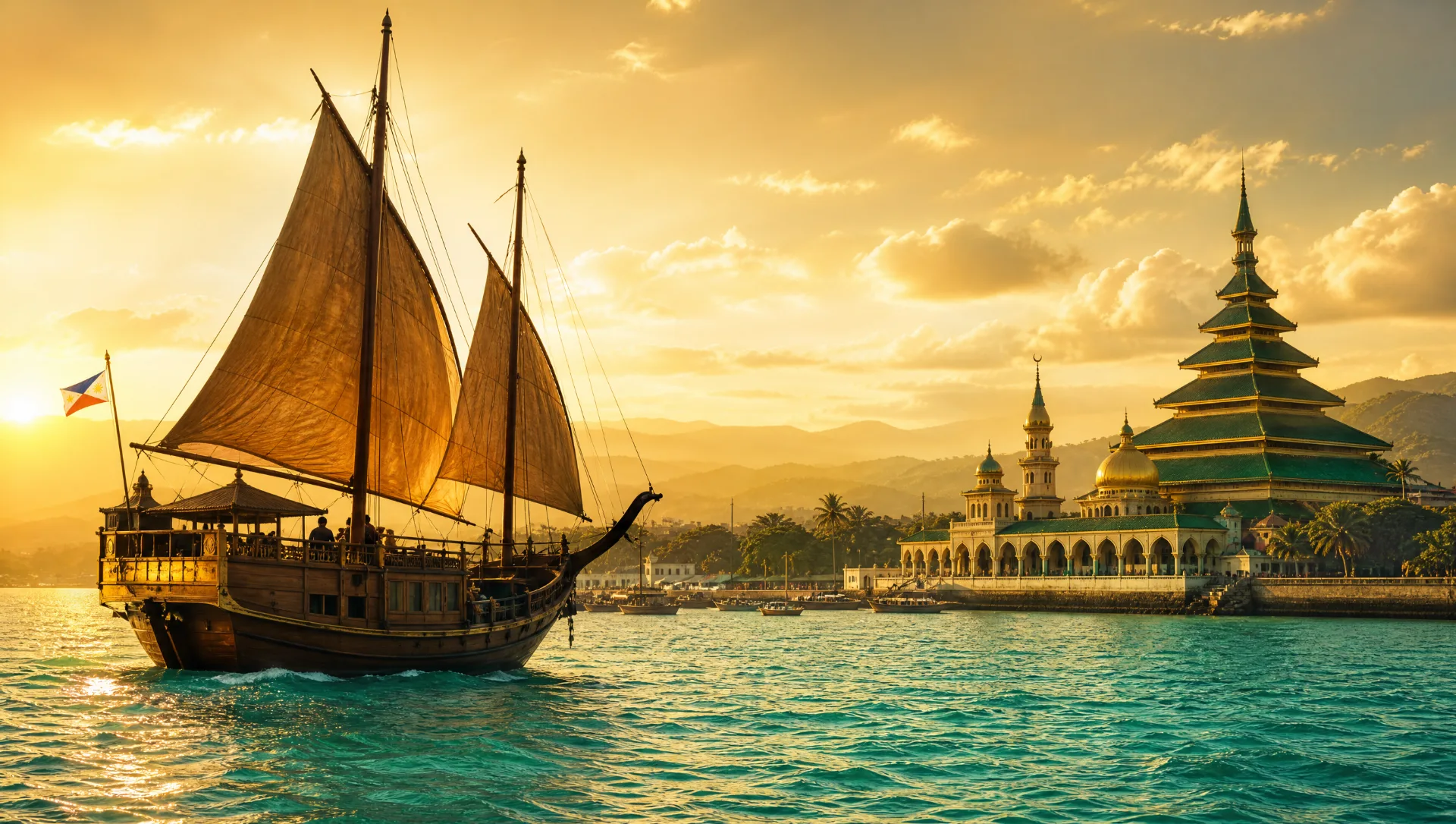
The introduction of Islam to the Philippine archipelago did not occur through military conquest, but through maritime trade routes connecting the Middle East, India, and Southeast Asia.
In the 14th century, Arab, Persian, and Malay traders actively sailed the region. Among them, the Arab scholar and preacher Karim ul-Makhdum landed in Sulu in 1380. He laid the foundations of the Sunni faith by building the country's first mosque on Simunul Island. His piety and medical knowledge facilitated the peaceful conversion of local chiefs.
Key Stages of Expansion
- 1380: Arrival of Karim ul-Makhdum in Sulu and the founding of the first mosque.
- 1450: Arrival of Sharif Abu Bakr (Sharif ul-Hashim) and the founding of the Sultanate of Sulu.
- 1515: Arrival of Sharif Kabungsuwan in Mindanao, leading to the creation of the Sultanate of Maguindanao.
- 1565: Beginning of the Spanish expedition of Legazpi and the start of the conflict against Muslim populations.
The process of Islamization relied on respecting local social structures. Arab missionaries often allied themselves through marriage with ruling families, thereby consolidating their spiritual and political influence.
The Founding and Organization of the Sultanate of Sulu
In 1450, an Arab scholar originally from Hadhramaut (Yemen), Sharif ul-Hashim, married the daughter of the local chief of Sulu and founded the Sultanate of Sulu. He became its first sultan under the regnal name of Sultan Sharif.
This new state was not only a religious entity, but a major political and economic power in Southeast Asia. The sultanate unified the various tribes of the archipelago under a single law, combining Islamic law (Sharia) and customary law (Adat).
Trade in pearls, spices, and bird's nests with Imperial China and neighboring islands ensured the financial prosperity of the sultanate. A few decades later, in the early 16th century, the Sultanate of Maguindanao was founded on the island of Mindanao, reinforcing the Islamic presence in the South.
The Philippine sultanates had a centralized administration, active diplomacy, and an organized army. They were internationally recognized, notably by the Ottoman Empire and the Qing dynasty in China.
Centuries of Resistance Against Colonizers
In 1521, Ferdinand Magellan landed in the Philippines. In 1565, Spain began the systematic colonization of the archipelago, which it named in honor of King Philip II. The Spaniards, fresh from the Reconquista in the Iberian Peninsula, referred to the local Muslims as "Moros" (Moors).
For more than 300 years, Spain attempted to evangelize and subjugate the Muslim South. This prolonged conflict, known as the Moro Wars, ended in a relative failure for Madrid. While the North and Center of the archipelago were heavily Christianized, the South retained its independence and Islamic identity.
| Region of the Country | Status Under Spanish Occupation | Dominant Religion | Local Political Structure |
|---|---|---|---|
| North (Luzon & Visayas) | Fully colonized and assimilated | Catholicism | Spanish colonial administration |
| South (Mindanao & Sulu) | Unsubjugated, continuous armed resistance | Sunni Islam | Autonomous sovereign sultanates |
At the end of the 19th century, the United States succeeded Spain after the Spanish-American War (1898). The Americans forcibly integrated the southern Muslim territories into the borders of the modern Philippines, initiating a new phase of political tensions and economic marginalization.
Mindanao Today: Preserved Autonomy
Why has Mindanao remained the only Muslim-majority region in the Philippines? The answer lies in the continuous resistance of its inhabitants to cultural assimilation.
After decades of demands and negotiations in the 20th century, the Philippine government recognized the historical specificity of the South. In 2019, the creation of the BARMM (Bangsamoro Autonomous Region in Muslim Mindanao) sealed this recognition.
This autonomous region allows Filipino Muslims to manage their local affairs, implement Islamic finance, and apply Muslim personal law, while remaining part of the Philippine state.
Today, it is estimated that Muslims represent about 6 to 8% of the total population of the Philippines (approximately 7 million people), concentrated mainly in western Mindanao and the island provinces of Sulu, Tawi-Tawi, and Basilan.
FAQ
What is the oldest mosque in the Philippines?
The Sheik Karimal Makdum Mosque, located on Simunul Island (Tawi-Tawi province), was built in 1380. Although it has been rebuilt several times, its original pillars made of precious wood are still preserved within the current structure.
Who are the "Moros" today?
The term "Moro" today brings together thirteen indigenous ethnolinguistic groups of Mindanao and Sulu sharing the Muslim faith (such as the Tausug, Maranao, and Maguindanaoans). It is a proudly claimed cultural and political identity.
Is Islam officially recognized by the Philippine government?
Yes. In addition to the autonomous status of the BARMM region, the Philippines legally recognizes Sharia courts for Muslim family law, and national Islamic holidays (such as Eid al-Fitr and Eid al-Adha) are public holidays throughout the country.
Muslim Map
🕌 Trouvez des adresses halal près de vous
Explorez la carte, filtrez par certification et découvrez les avis de la communauté.