

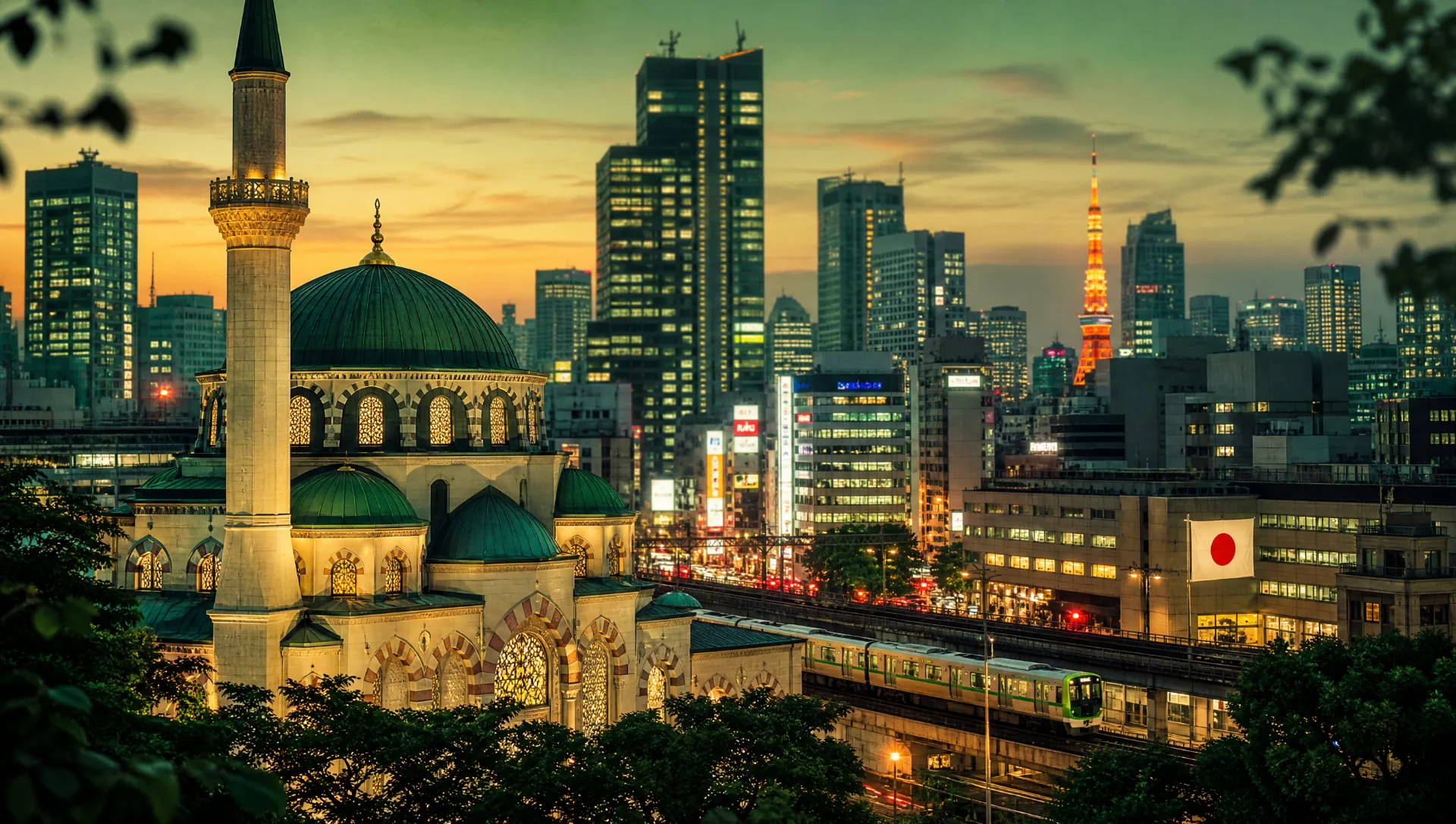
Where to pray in Tokyo: A practical guide to mosques and prayer rooms
Discover our complete guide to performing your prayers in Tokyo. Find major mosques, prayer rooms in train stations, and the best practical tips for your trip to Japan.
L'équipe Muslim Map
Guides halal & voyages musulmans · Mis à jour le 7/25/2026
Traveling to Japan is a unique experience, but finding prayer spaces in a metropolis of 37 million people can seem daunting. Fortunately, Tokyo has adapted significantly to the needs of Muslim visitors in recent years.
This practical guide lists the city's main mosques, hidden prayer spaces in train stations and shopping malls, as well as backup solutions to pray with peace of mind.
Major Mosques in Tokyo
Tokyo is home to several long-established mosques, serving as major spiritual and cultural centers for the local Sunni community.
Tokyo Camii (Shibuya)
The Tokyo Camii is the largest mosque in Japan. Rebuilt in a magnificent Ottoman architectural style, it impresses with its majestic dome and detailed calligraphy. It also houses a Turkish cultural center and a very well-stocked halal supermarket.
Tokyo Camii & Turkish Culture Center
- Address: 1-19 Oyama-cho, Shibuya-ku, Tokyo
- Access: 5-minute walk from Yoyogi-Uehara Station (Odakyu and Chiyoda lines)
- Hours: Open daily from 10:00 AM to 6:00 PM for visits, accessible for all daily prayers
- Amenities: Reserved space for women in the mezzanine, facilities adapted for Wudu (ablutions)
Otsuka Mosque (Toshima)
Managed by the Japan Islamic Trust, the Otsuka Mosque is an essential landmark for Muslims in Tokyo. Less monumental than Tokyo Camii, it is extremely active in social work and welcoming converts and travelers.
- Address: 3-42-7 Minami-Otsuka, Toshima-ku, Tokyo.
- Access: A 3-minute walk from Otsuka Station (JR Yamanote Line).
- Facilities: Divided into several floors, with a space dedicated exclusively to women.
Asakusa Mosque (Dar al-Arqam)
Located near the famous Senso-ji Temple, this four-story mosque built in 1998 is managed by the Islamic Circle of Japan. It is very convenient during a day of sightseeing in the historic Asakusa district.
- Address: 1-9-12 Higashi-Asakusa, Taito-ku, Tokyo.
- Access: About a 15-minute walk from Asakusa Station.
Prayer Rooms in Train Stations and Shopping Malls
To accommodate the flow of tourists, Japanese authorities and railway companies have set up multi-faith prayer spaces called Prayer Rooms or Silence Rooms.
In Major Train Stations
- Tokyo Station: Located inside the ticket gates (JR East Travel Service Center, near the Marunouchi North Exit). Ask the reception staff for access.
- Shinjuku Station: A modern prayer room is accessible near the Southeast Exit, managed by the local tourist information office.
In Department Stores (Shopping)
The Takashimaya Times Square department store in Shinjuku (11th floor) provides a free and very clean prayer room. It is equipped with a water station for ablutions and separates men's and women's spaces with curtains.
| Location | District | Main Access | Ablution Facilities |
|---|---|---|---|
| Tokyo Camii | Shibuya | Yoyogi-Uehara Station | Yes (Full) |
| Otsuka Mosque | Toshima | Otsuka Station (Yamanote) | Yes (Full) |
| Takashimaya Shinjuku | Shinjuku | Shinjuku Station (South Exit) | Yes (Dedicated space) |
| Tokyo Station | Chiyoda | Marunouchi North Exit | Yes (Limited) |
Backup Options: Universities, Hotels, and Parks
If you find yourself far from a mosque or an equipped station, other options are available to perform your daily prayers.
University Campuses
Several major universities in Tokyo (such as the University of Tokyo or Sophia University) have prayer rooms or Muslim student associations. Although theoretically reserved for students, they can be helpful in a pinch if you politely ask for access at the campus reception.
Hotel Rooms
In Japan, discretion is a core value. Praying in your hotel room remains the simplest and most peaceful option. Many establishments accustomed to international guests provide a prayer mat upon request and indicate the direction of the Qibla.
— Planning Tip Download an offline Qibla compass app before your departure. In Japan, the Qibla direction is approximately 293° (West-North-West).
Etiquette for Praying in Japan
Respect for public order and cleanliness is essential in Japan. Here are a few tips to avoid any misunderstandings with local residents.
✅ Dos
- Use dedicated spaces whenever possible.
- Keep the restrooms clean after performing your ablutions (wipe up any water on the floor).
- Ask for permission before settling into a quiet corner of a private establishment.
❌ Don'ts
- Avoid praying in narrow passageways in stations or emergency corridors.
- Do not perform your ablutions directly in public park sinks if it involves getting the floor excessively wet.
FAQ
How do I find the Qibla direction in Tokyo ?
The Qibla faces West-North-West, specifically at an average angle of 293 degrees from Tokyo. Use a reliable GPS app to adjust your position.
Are station prayer rooms free to use ?
No, access is entirely free. However, for some stations like Tokyo Station, you must contact the information desk to have the staff open the door for you.
Is it easy to perform ablutions (Wudu) in public spaces ?
Mosques and the Shinjuku Takashimaya room have suitable facilities. In other prayer rooms, a simple sink is available. It is advisable to carry small wet wipes or a water bottle to remain discreet.
Muslim Map
🕌 Trouvez des adresses halal près de vous
Explorez la carte, filtrez par certification et découvrez les avis de la communauté.