

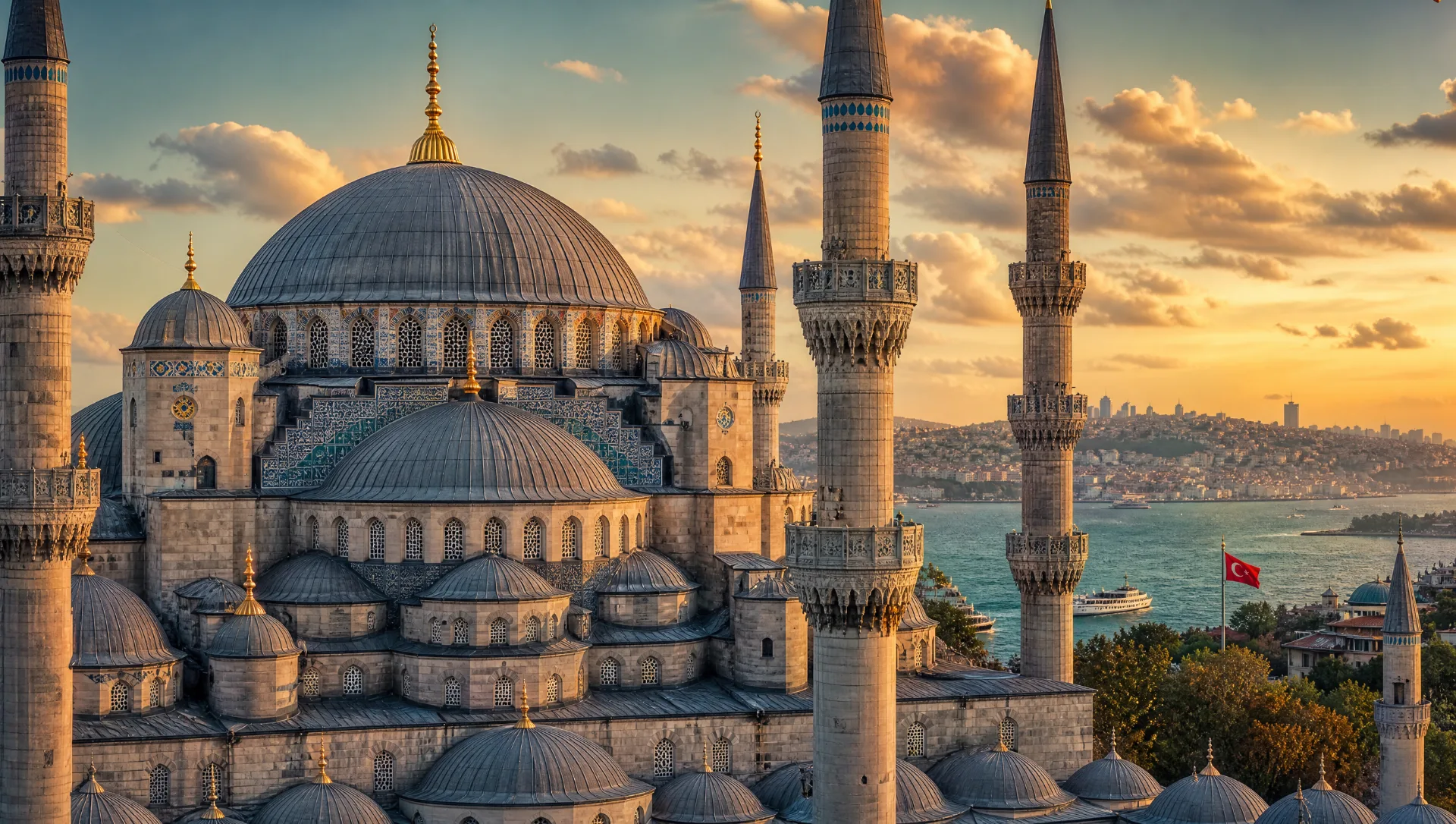
Visiting Istanbul's Mosques: Sultanahmet, Süleymaniye, and Hagia Sophia
Prepare for your visit to Istanbul's three iconic mosques. This practical guide covers non-prayer opening hours, essential etiquette rules, and the Ottoman architectural gems to observe.
L'équipe Muslim Map
Guides halal & voyages musulmans · Mis à jour le 7/26/2026
Istanbul, a historic crossroads between East and West, possesses an exceptionally rich Islamic heritage. Its imperial mosques, which dominate the city's skyline, bear witness to the expertise of the greatest Ottoman architects.
For travelers and worshippers alike, visiting these buildings requires careful preparation to respect the sacred nature of the sites while appreciating their structural splendor. This guide presents three major mosques in Istanbul, their architectural features, and their access conditions.
Visit Etiquette and Common Rules
All active mosques in Istanbul enforce strict rules to preserve the sacredness of the prayer space.
Mandatory dress code for all:
- For women: Hair, shoulders, and knees must be fully covered. A headscarf (hijab) is required at the entrance.
- For men: Shorts above the knee and tank tops are prohibited. Decent attire (trousers and a t-shirt/shirt) is required.
- For everyone: Shoes must be removed before walking on the carpets. Lockers or plastic bags are provided at the entrance.
Sightseeing is suspended during the five daily prayers, as well as during the main Friday sermon (Jumu'ah). It is recommended to arrive between prayer times so as not to disturb the worshippers.
1. The Sultanahmet Mosque (The Blue Mosque)
Built between 1609 and 1616 during the reign of Sultan Ahmet I, it faces Hagia Sophia. It owes its Western nickname to the thousands of Iznik tiles that adorn its interior.
Non-Prayer Opening Hours
The mosque is open daily from 09:00 to 19:00 (temporary closure of about 30 to 45 minutes during each prayer, and extended closure on Friday mornings until the end of the Jumu'ah prayer).
Architectural Point of Interest: The Six Minarets
Unlike most Ottoman mosques, which have two or four minarets, Sultanahmet has six. At the time of its construction, this feature caused controversy, as only the Sacred Mosque in Mecca (Al-Masjid al-Haram) had as many. To resolve this dispute, the sultan funded the construction of a seventh minaret in Mecca.
2. The Süleymaniye Mosque
Erected by the famous imperial architect Mimar Sinan for Sultan Suleiman the Magnificent between 1550 and 1557, the Süleymaniye dominates Istanbul's third hill. It is considered by art historians to be the pinnacle of classical Ottoman architecture.
Non-Prayer Opening Hours
Access is possible daily from 09:00 to 18:00. Visitor numbers are generally less dense here than at Sultanahmet, offering a more peaceful atmosphere for contemplation.
Architectural Point of Interest: The Dome and Acoustic System
The main dome rises to a height of 53 meters. Mimar Sinan integrated 64 empty clay jars, embedded upside down in the dome's walls, acting as natural resonators. This system allowed the imam's voice to be heard clearly in every corner of the mosque, without any projection effort.
3. Hagia Sophia Mosque (Ayasofya-i Kebir Cami-i Şerifi)
A former Byzantine basilica built in the 6th century, converted into a mosque in 1453 after the conquest of Constantinople by Sultan Mehmed II, then turned into a museum in 1935, Hagia Sophia regained its status as an active mosque in July 2020.
Opening Hours and Access Conditions
Since January 2024, Turkish authorities have implemented a new visitor flow management plan:
- Worshippers (free access): The prayer area on the ground floor is reserved solely for those coming to perform prayer at the prescribed times.
- Visitors (paid access): The upper gallery is accessible via an entrance ticket (current rate available on site) to observe the architecture and mosaics. Visiting hours for the gallery are from 09:00 to 19:30.
Architectural Point of Interest: The Large Calligraphic Medallions
Inside the nave, suspended from the main pillars, are eight large circular wooden medallions covered in leather, with a diameter of 7.5 meters. Created by the famous calligrapher Kazasker Mustafa Izzet Efendi in the 19th century, they bear the names of Allah, the Prophet Muhammad (ﷺ), the first four caliphs (Abu Bakr, Umar, Uthman, Ali), and the Prophet's two grandsons, Hassan and Hussein.
Comparative Summary of the Three Buildings
| Mosque | Construction Period | Chief Architect | Notable Feature | Tourist Access |
|---|---|---|---|---|
| Sultanahmet | 1609 – 1616 | Sedefkar Mehmed Agha | Six minarets and blue tiles | Free (outside prayer times) |
| Süleymaniye | 1550 – 1557 | Mimar Sinan | Acoustics via integrated jars | Free (outside prayer times) |
| Hagia Sophia | 532 – 537 (rebuilt) | Isidore of Miletus & Anthemius | Imperial calligraphic medallions | Paid (upper gallery) |
Practical Recommendations (Dos & Don'ts)
✅ Dos
- Prioritize the morning: Visit the mosques between 09:00 and 11:00 to avoid the afternoon crowds.
- Bring your own clothing: Although spare headscarves and long skirts are sometimes loaned at the entrance, having your own items is more hygienic and faster.
- Respect the silence: Speak softly and silence your mobile phones as soon as you enter the mosque courtyard.
❌ Don'ts
- Do not photograph worshippers: Avoid pointing your lenses at people performing ablutions or praying.
- Avoid Friday afternoons: This is the day of the weekly congregational prayer, and mosques remain very busy with locals for a large part of the day.
- Do not walk on prayer areas with shoes: Even if you remain behind the wooden barriers defining the tourist area, strictly respect the boundary set for removing shoes.
FAQ
Can non-Muslims enter these mosques?
Yes, all three featured mosques are open to visitors of all faiths, provided they respect the dress code and non-prayer visiting hours.
Do women need to buy a headscarf on site?
No, it is not necessary to buy a headscarf. At the entrance of Sultanahmet and Süleymaniye, clean headscarves are provided free of charge for visitors who do not have one. At Hagia Sophia, vending machines offer paid disposable headscarves if you do not have your own.
Can we take photos inside the mosques?
Photos without flash are permitted for personal use. The use of professional tripods and taking photos of people praying are prohibited.
Muslim Map
🕌 Trouvez des adresses halal près de vous
Explorez la carte, filtrez par certification et découvrez les avis de la communauté.