

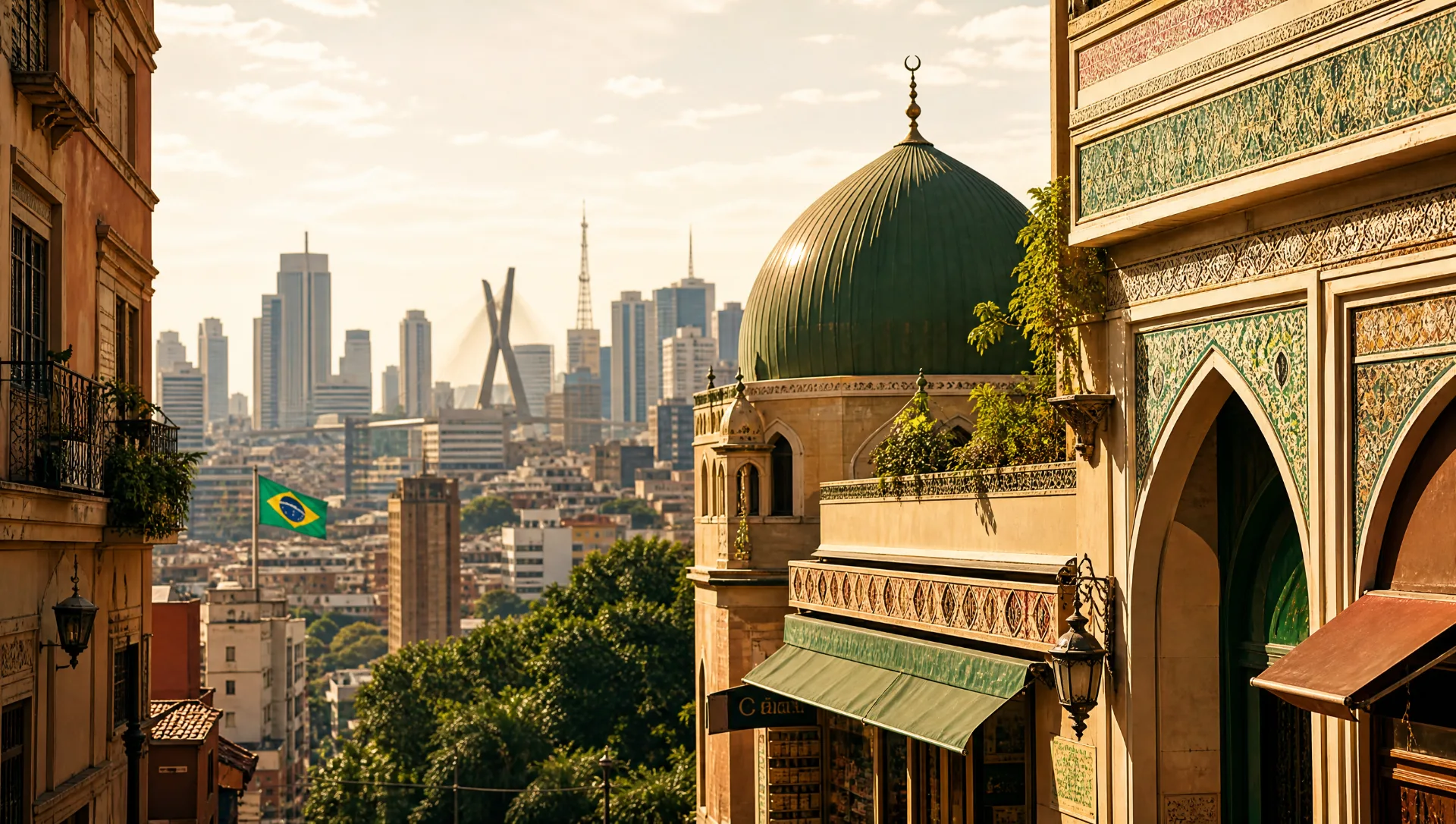
Halal travel in Brazil: the little-known Muslim community
Discover the fascinating history of Islam in Brazil, shaped by the legacy of slavery and Syrian-Lebanese immigration. This practical guide offers concrete points of reference, addresses in São Paulo, and tips for a successful halal trip.
L'équipe Muslim Map
Guides halal & voyages musulmans · Mis à jour le 7/26/2026
Brazil instantly evokes football, carnival, and fine sandy beaches. Yet, this South American giant is also home to a rich Islamic history and a vibrant, albeit minority, Muslim community.
For the Muslim traveler, exploring Brazil is an opportunity to discover a unique heritage born from successive waves of migration. Here are the keys to understanding this community and planning your trip with peace of mind.
A History Etched in Time: From Africa to the Levant
The presence of Islam in Brazil is not recent. It was structured around two major historical periods that left an indelible mark on the country's cultural landscape.
The Painful Legacy of Slavery
In the 19th century, many Muslims from Africa, mainly from the Yoruba and Hausa peoples, were deported to Brazil as slaves. Known locally as the Malês, many of them knew how to read and write Arabic, unlike their masters.
In 1835, in Salvador (Bahia), the Malês led the largest urban slave revolt in the Americas. Although suppressed, this uprising marked Brazilian history and stands as a testament to the spiritual resistance of these early Muslims.
The Syrian-Lebanese Immigration Wave
The second wave began at the end of the 19th century and intensified after the First World War. Thousands of Syrian and Lebanese families settled in Brazil, particularly in São Paulo.
These immigrants quickly integrated into the textile and retail trade. Today, it is estimated that Brazil is home to between 800,000 and 1.5 million people of Arab descent, a significant portion of whom are of the Muslim faith.
Timeline of Islam in Brazil:
├── 1835: Malês Revolt in Salvador (Bahia)
├── 1929: Foundation of the first Muslim association in São Paulo
└── 1960: Inauguration of the Mesquita Brasil, the country's first mosque
Practical Landmarks for the Traveler in São Paulo
The megacity of São Paulo is the beating heart of the Brazilian Muslim community. This is where you will find the most suitable infrastructure.
Mesquita Brasil: The Pioneer of Latin America
Located in the historic district of Cambuci, the Mesquita Brasil is the oldest mosque in the country. Inaugurated in 1960, it impresses with its traditional architecture and slender minarets. It is an essential place of exchange to meet local worshippers.
Mesquita Brasil (Mosque of Brazil)
- Address: Av. do Estado, 5302 - Cambuci, São Paulo - SP
- Access: Accessible by metro (Dom Pedro II station)
- Services: Daily prayers, Friday prayer (Jummah), library, and visitor reception.
The Brás District and Rua 25 de Março
The Brás neighborhood and the famous shopping street Rua 25 de Março were shaped by Syrian-Lebanese merchants. There you will find many fabric shops, but above all a multitude of small restaurants offering Levantine specialties (esfihas, tabbouleh, hummus, shawarma).
Although many restaurants in the area are owned by Lebanese Christians, several establishments are run by Muslims and display clear halal certification. Do not hesitate to ask for confirmation ("É halal?").
Practical Guide: Eating and Practicing in Brazil
Brazil is one of the largest exporters of halal meat in the world (thanks to organizations like FAMBRAS). However, finding certified halal meat served in local restaurants outside of Arab neighborhoods remains a challenge.
| Situation | Alternative / Solution |
|---|---|
| Traditional Restaurants | Opt for fish, seafood, and the famous Açaí. |
| Churrascarias (Steakhouses) | Generally not halal; prefer the very comprehensive vegetarian buffet options. |
| Arab Neighborhoods | Numerous certified halal restaurants in São Paulo and Foz do Iguaçu. |
Travel Tips: Do & Don't
::: ✅ Do
- Taste the local fruit juices: Brazil offers an incredible variety of fresh exotic fruits (maracuja, caju, acerola) perfect for staying hydrated.
- Visit Foz do Iguaçu: This city is home to the famous waterfalls, but also a large Muslim community and the beautiful Sunni Omar Ibn Al-Khattab Mosque. :::
::: ❌ Don't
- Consume unlabelled meat: Even though Brazil produces halal meat for export, the meat sold in standard local supermarkets is generally not halal.
- Neglect basic safety: As with any traveler in Brazil, stay vigilant in major urban areas and avoid displaying valuables. :::
FAQ: Traveling to Brazil as a Muslim
Is it easy to find prayer rooms in Brazil?
Outside of major cities like São Paulo, Rio de Janeiro, or Foz do Iguaçu, mosques are rare. It is advisable to download a Qibla finder app and carry a travel prayer mat.
How to identify certified halal products in supermarkets?
Look for the logos of FAMBRAS Halal or Cdial Halal, which are the two main certifiers in the country. These logos can sometimes be found on frozen poultry in supermarkets.
How do locals perceive female travelers wearing the hijab?
The Brazilian people are generally very warm, welcoming, and accustomed to cultural diversity. Women wearing the hijab typically do not encounter any hostility, though they may arouse curiosity in less touristy regions.
Muslim Map
🕌 Trouvez des adresses halal près de vous
Explorez la carte, filtrez par certification et découvrez les avis de la communauté.